
Its Chip Suppliers Bought $26 Billion First: Anthropic Sets an IPO Range Worth Up to $1.4 Trillion
On the morning of Tuesday, November 10, Anthropic announced it had launched the roadshow for its initial public offering. Its second amended S-1, filed the same day, filled in the blanks that had sat empty for two weeks.
The price range is $70 to $78 a share for 825 million shares of Class A common stock, to be listed on Nasdaq under the ticker ANT. At the top of the range, the public offering would raise about $64.35 billion.
Another line in the same filing deserves more attention. Google, Nvidia, AMD, Broadcom, Micron, Microsoft and TSMC Partners have agreed to buy a combined $26 billion of Class N common stock at the IPO price. Those shares carry no vote and are not covered by the underwriters’ lock-up agreements.
Those seven companies are, more or less, Anthropic’s compute supply chain: chips, memory, foundry and cloud.
CNBC calculates that the top of the range implies a fully diluted valuation of about $1.405 trillion. Anthropic’s last private round, in May, valued it at $965 billion post-money. Around September, several outlets reported it was considering something close to $2 trillion.
This is the fourth time in two weeks I have written about this IPO. Earlier pieces covered the losses and growth in the prospectus, the risk factor on AI accelerating AI research, and the third-quarter operating loss. This one sticks to what is new: the terms, the valuation, the $26 billion, and what it means to go public in the middle of an AI sell-off.
The term sheet
Here are the numbers, from Anthropic’s roadshow announcement and the November 10 amended S-1, with dates from CNBC:
- Price range: $70 to $78 a share. According to BeInCrypto and Stocktwits, an earlier, withdrawn version of the filing said $70 to $80.
- 825 million shares. About 801 million are new shares from the company and about 23.65 million come from existing holders. The company gets nothing from the latter.
- An option for 123.75 million more. Underwriters can buy these from the company within 30 days. That is 15% of the base deal.
- Public offering: $57.75 billion to $64.35 billion. That is simply 825 million shares times each end of the range, before underwriting fees.
- With the private placement, up to about $90.4 billion. Anthropic estimates it will net about $84.6 billion from the IPO and the placement at the $74 midpoint after discounts and expenses, or about $93.7 billion if the underwriters exercise their full option.
- Goldman Sachs and Morgan Stanley lead the deal. FinanceFeeds reports a syndicate of 22 banks.
- Timing. CNBC, citing people familiar with the matter, says pricing is planned for November 18 and trading for November 19. Anthropic’s announcement gives no dates.
There are two ways to state the valuation, and coverage often mixes them up.
After the offering and the placement, the filing shows about 7.43 billion Class A shares and about 5.66 billion Class N shares, roughly 13.09 billion in total. On that count, my rough math puts the company at about $920 billion at $70 and about $1.02 trillion at $78, in line with FinanceFeeds. That is the shares-outstanding basis.
Add in employee options, restricted stock units and other securities that may become shares later, and you get the fully diluted basis. CNBC puts the top of the range at $1.405 trillion; BeInCrypto gives a range of $1.26 trillion to $1.41 trillion. Outlets differ on what to include, and the prospectus itself states no valuation.
So “$1.4 trillion” is the generous way of putting it. “About $1 trillion” describes the same price.
From $2 trillion down to $1.4 trillion, and maybe back up
The price was negotiated down step by step.
- May: $965 billion. Anthropic’s post-money valuation after its Series H, as published on its website.
- Around September: close to $2 trillion. According to Fortune and CNBC, Anthropic had been considering this figure.
- Around November 2: $1.5 trillion to $1.6 trillion. As I noted last time, The Wall Street Journal reported that institutional investors told Anthropic and its advisers the valuation belonged in this range.
- November 6: “even $1.5 trillion is now in doubt.” CNBC quoted shareholders, one of whom called that number a “stretch.”
- November 10: a range of $70 to $78.
A day after the range came out, the mood shifted again. Fortune and ZeroHedge, relaying a Financial Times report citing five people familiar with the deal, said early roadshow demand was strong enough that the banks were weighing a price above the range, which could lift the valuation past $1.5 trillion. ZeroHedge, citing Bloomberg, said orders were several times the number of shares on offer. CNBC’s sources said the book was already covered within the range on an allocable basis.
All of this comes from anonymous sources. Anthropic has not confirmed it or changed the range.
The FT report had one more detail: three of Anthropic’s investors said the company cares more about raising as much money as possible than about maximizing its valuation. That fits the prospectus. As of and after September 30, Anthropic had signed compute purchase and lease commitments totaling about $900.9 billion, about $451.6 billion of it due before the end of 2030 and about $70.7 billion due in the 12 months after September 30. On September 30 it had $146.6 billion of liquidity.
For a company carrying a $900 billion compute bill, an extra $10 billion of cash matters far more than a few more points of valuation.
$26 billion from the people who sell it compute
Now the private placement. The filing lists each buyer’s commitment at the $74 midpoint:
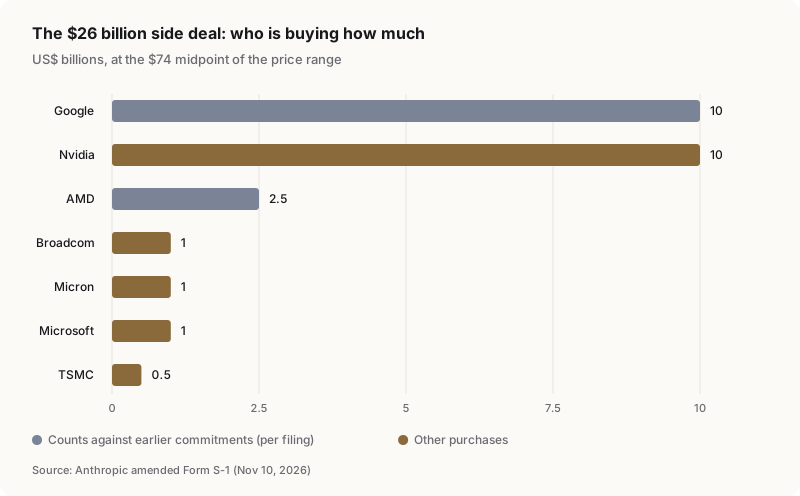
Google and Nvidia are each in for about $10 billion, AMD about $2.5 billion, Broadcom, Micron and Microsoft about $1 billion each, and TSMC about $500 million.
Read closely, and some of this $26 billion is not new money:
- Google’s $10 billion counts against an old commitment. The filing says Google is funding part of investment obligations it already took on in a note purchase agreement signed in March. Once the placement closes, the financing Anthropic can draw under those agreements falls by $10 billion.
- So does AMD’s $2.5 billion. In July, Anthropic and AMD signed a hardware supply framework under which AMD agreed to buy up to $5 billion of Class N stock at Anthropic’s election if certain conditions were met. The placement cuts that commitment by $2.5 billion.
- For the other five, the filing does not say the money comes from existing commitments.
In other words, at least $12.5 billion of the $26 billion is money already agreed, moved to a new date and turned into post-IPO stock.
The more interesting question is who these seven are. The prospectus is blunt in its risk factors: Amazon, Google and Microsoft “simultaneously serve as our investors, customers, distribution partners, and competitors,” and Broadcom “simultaneously serves as a supplier and lessor.” Nvidia and AMD sell GPUs, Micron sells memory, and TSMC makes chips for everyone.
The money roughly runs in a loop. Suppliers buy Anthropic stock; Anthropic uses the money it raises to buy their chips, memory and cloud capacity. The filing says “substantially all” of its $900 billion in commitments relate to compute and infrastructure.
My view is that this is neither fraud nor unusual. Suppliers locking in big customers with equity is nothing new in AI. But it does mean two things.
First, the $26 billion should not be read as demand from independent investors. These companies are buying, in large part, to keep a customer that spends tens of billions a year on compute.
Second, the risk is linked across the supply chain. If Anthropic’s growth slows and its compute goes unused, the pain is not limited to its shareholders. It also reaches these seven companies’ order books and the Anthropic stock on their balance sheets. Going the other way, if those suppliers’ shares keep falling, it will be hard for sentiment toward Anthropic to stay untouched.
One more detail: Amazon, which the prospectus names alongside Google and Microsoft as an investor, customer and competitor, is not among the seven. The filing does not say why, and I won’t guess.
How much the public gets, and how much say
Ordinary investors are getting a small slice.
According to the filing, new investors will hold 825 million shares after the offering, about 6.3% of combined Class A and Class N shares. Existing holders will hold about 91%.
CNBC, citing people familiar with the matter, says Anthropic is targeting about 20% of the offering for retail investors, versus a typical 5% to 10%. The filing gives no figure; it only lists “potential allocation to retail investors of a minority of shares” among the things that could make the stock volatile. The filing also says some directors and their affiliates have indicated interest in buying up to $303 million of stock at the IPO price, which is non-binding.
Those who do get shares will have little say over the company. Voting is split across several layers:
- Class A: one vote per share. This is what the IPO sells.
- Class N: no vote. This is what the seven suppliers are buying, and much of the earlier preferred stock and convertible notes converts into it.
- Class F: a single share, held by an LLC of the seven co-founders. It carries 50.1% of the total voting power on general matters and no economic rights.
- Class T: also a single share, held by the Long-Term Benefit Trust. The trust elects and removes the Class T directors, who make up a majority of the board.
The upshot: the founders control the shareholder vote, the trust controls the board, and public shareholders can reach neither. The filing says Anthropic expects to be a “controlled company” under Nasdaq rules, which exempts it from some governance requirements.
The lock-ups matter too. Most existing holders are locked up for 180 days, and co-founders and holders of more than 0.5% of the fully diluted shares for 365 days. There are two exceptions. Non-founder directors, officers, employees and former employees can sell up to 10% of their locked-up shares from the first day of trading. And about 3.6 billion shares may be released before the 180 days are up.
Ringing the bell in a sell-off
The roadshow lands in the ugliest stretch for AI stocks this year.
On Thursday, November 5, Nvidia fell 9.26% to close at $181.60, its worst day since the DeepSeek shock, erasing about $450 billion of market value. The Nasdaq Composite fell about 5.5% that day. I wrote about that day in 41 votes, 40 noes: after the midterms gave Democrats both chambers of Congress, investors worried data centers would face tougher scrutiny. By IBTimes’ count, Nvidia was worth nearly $1.4 trillion less than at its October 6 peak. On Monday, November 9, Nvidia’s board opened an independent investigation into Jensen Huang and the stock fell more than 4%, which I covered in After the apology letter.
So this IPO is being priced in a market that has grown noticeably more cautious about AI.
There are two reference points. One is SpaceX, which listed in June and, according to Reuters, raised $75 billion, the largest IPO ever; even at the top of its range, Anthropic’s public offering alone would be smaller. The other is Saudi Aramco, which raised about $25.6 billion in 2019 and held the record for years before SpaceX.
Some investors are sounding warnings. ZeroHedge reports that Jack Selby, a managing partner at Peter Thiel’s family office, said on Bloomberg TV that an IPO falling well short of its projected valuation would matter a great deal coming from the most anticipated AI company, adding: “just imagine where it’s going to go after the lockups expire.” ZeroHedge also listed examples: Klarna and StubHub were both heavily oversubscribed and both later fell below their IPO prices. On the other side, Fortune reports that Dan Ives of Yorkville Ives & Co. favors pricing around $1 trillion, arguing that making the deal digestible for the market matters more than the last turn of valuation.
My view: oversubscription tells you many people want to buy. It does not tell you the price is a good one. In a $60-billion-plus deal, large institutions often inflate their orders so they are not shut out. Real demand only becomes clear weeks after listing, or even after the lock-ups end.
For anyone thinking of buying in
This is not investment advice. These are the things I think are worth sorting out after reading the prospectus.
- Pin down the valuation basis. When you see “$1.4 trillion” and “$1 trillion,” ask whether it is fully diluted or shares outstanding. Compare on the same basis with Nvidia, Microsoft or SpaceX; don’t set one company’s fully diluted number against another’s market cap.
- Work out the revenue multiple. CNBC and Fortune report annualized revenue of about $81 billion at the end of October, up about $10 billion from late September. At $1 trillion on shares outstanding, that is roughly 12 times annualized revenue; at $1.4 trillion fully diluted, about 17 times. That is not crazy at this growth rate, but only if the growth holds.
- Know what rights you are buying. Class A shares vote, but between the founders and the trust, public shareholders have essentially no say in electing directors. If governance matters to you, accept that up front.
- Mark the dates. Pricing on November 18 (per CNBC); employees can sell 10% of their locked-up shares on day one; large unlocks follow at 180 and 365 days, with about 3.6 billion shares possibly released early. Price swings around those dates often have nothing to do with the business.
- If you are outside the US, check your access first. Getting IPO allocations through a broker usually comes with asset thresholds and caps, and hot deals are heavily rationed. Buy after listing, and the price may be far from the offer price.
- Read the $900 billion compute bill alongside the risk factors. The prospectus spends a lot of space on compute commitments, supplier relationships and the safety risks of AI accelerating AI research. That is what most sets this company apart from an ordinary tech stock.
Final thoughts
When the prospectus went public two weeks ago, the number everyone fixed on was the $80.7 billion book loss. Last week it was the third-quarter operating loss. This week it is the price.
Reading the three filings together, what I notice most is how it is raising money. A little over 6% of the shares go to the public, $26 billion comes from its own suppliers, and the votes stay with the founders and the trust. That looks less like a company handing itself to the market and more like one borrowing a very large sum from it while keeping both hands on the wheel.
The money will go toward a compute bill that runs to 2045. Next Wednesday’s pricing, on November 18 US time, will be the market’s first quote on that bill.
References
- Anthropic, Anthropic launches roadshow for proposed initial public offering, 2026-11-10
- Anthropic, PBC, Form S-1/A Registration Statement (Amendment No. 2), 2026-11-10
- CNBC, Anthropic sets IPO price range of $70 to $78, looks to start trading Nov. 19, sources say, 2026-11-10
- Fortune, Anthropic sets IPO range valuing it at up to $1.4 trillion amid AI stock sell-off, 2026-11-10
- Fortune, Anthropic sets a $1.4 trillion IPO target, but bankers may already be aiming higher, 2026-11-11
- ZeroHedge, Anthropic’s IPO Order Book Reportedly Booms But Graveyard Of ‘Oversubscribed Deals’ Signals Warning, 2026-11-11 (relaying the Financial Times and Bloomberg)
- BeInCrypto (via Yahoo Finance), Why Anthropic Cares More About Cash Than Its $1.5 Trillion Price Tag, 2026-11-11
- International Business Times (via Yahoo Finance), Anthropic is Seeking to Raise Over $90.4 Billion, 2026-11-11
- FinanceFeeds, Anthropic IPO Date: $70-$78 Price Range Set, Trading Reported From 19 November, 2026-11-11
- IBTimes UK, Nvidia Has Lost Nearly $1.4 Trillion Since Its October Record as AI Stocks Face a Fresh Rout, 2026-11-06
- 24/7 Wall St., Nvidia Just Had Its Worst Day Since DeepSeek, Losing About $450 Billion, 2026-11-06
- Reuters (via The Star), From SpaceX to Saudi Aramco: World’s biggest IPOs as Anthropic’s blockbuster listing looms, 2026-09-29