
An $80.7 billion loss, and an operating profit: reading Anthropic's S-1

On October 26, Anthropic publicly filed its S-1 with the US Securities and Exchange Commission. It plans to list on Nasdaq under the ticker ANT.
The document runs past 300 pages. The price range, the share count and third-quarter revenue are still blank, to be filled in by later amendments. Of the numbers that are filled in, two stand out: $16.3 billion of revenue in the first half of 2026, and a net loss of $80.7 billion.
A loss roughly five times revenue. Read those two figures alone and the obvious conclusion is that the company is burning money at an absurd rate. Read the income statement line by line and the conclusion nearly flips: in the second quarter of 2026, Anthropic posted an operating profit of $974 million.
I spent a morning with the filing’s financial summary, quarterly data, risk factors and governance sections. This piece tries to answer four questions: where the loss comes from, what is holding the growth up, what the real bet is, and which risk factors are worth reading carefully.
Most of the $80.7 billion is on paper
Start with the loss.
Anthropic’s operating loss for the first half of 2026 was $693 million, smaller than the $2.1 billion it lost in the first half of 2025. What carries the net loss to $80.7 billion is a line below operations: “change in fair value of convertible notes, derivative liabilities, and SAFEs,” which booked $72.4 billion of expense in the half.
Where does that come from? Anthropic issued convertible notes in its early years, a large share of them to Amazon. The notes can later convert into stock on agreed terms, so the higher the company’s valuation, the more the notes are worth. In accounting terms the notes are a liability, and when the fair value of a liability rises, the difference is recorded as an expense. The filing puts it plainly: the changes were “primarily driven by an increase in the fair value of our outstanding convertible promissory notes resulting from an increase in our enterprise valuation.” The charge was largest in the second quarter, after the Series H financing in May and June lifted the valuation again.
Hence the counterintuitive part: the more the company is worth, the bigger this “loss” gets.
There is also $8.8 billion of “other expense.” According to the filing, it mainly reflects the initial recognition and fair value changes of assets and liabilities under note purchase agreements. Again, an accounting measurement, not cash out the door.
Set those two items aside and look at quarterly operating results. Anthropic lost $935 million, $1.2 billion, $3.09 billion and $2.84 billion in the four quarters of 2025 (the third quarter includes a $1.5 billion charge to settle the Bartz copyright case), $1.67 billion in the first quarter of 2026, and then earned $974 million in the second.
That does not mean Anthropic is reliably profitable. As of June 30 its accumulated deficit was $132.9 billion, of which $113.2 billion came from these fair value changes, and the filing says outright: “We expect our costs will increase over time and our losses will continue.” But the first thing to do with this prospectus is to separate paper losses from operating losses. The company will keep recognizing fair value changes until the instruments convert, are repaid, or are otherwise settled.
Growth: fourteen times in a year
The quarterly revenue numbers show the speed better than any annual figure:
- Q1 2025: $376 million;
- Q4 2025: $2.04 billion;
- Q1 2026: $4.73 billion;
- Q2 2026: $11.56 billion.
Second-quarter revenue rose 1,368% year over year. On an annual basis, revenue was $41 million in 2023, $386 million in 2024, and about $4.6 billion in 2025 (summing the quarters).
By September 30, more than 11,900 customers had contributed over $100,000 in trailing-twelve-month revenue, more than 1,900 over $1 million, and about 250 over $10 million. Eighteen months earlier, at the end of March 2025, only about 400 customers cleared the $100,000 bar. Headcount grew from about 940 at the end of 2024 to about 5,300, and the company calculates TTM revenue per employee at more than $6.6 million.
The number most likely to end up in headlines is “net revenue retention of approximately 900%.” Check how it is defined:
- It compares quarters, not years. It divides the last three months of revenue by the same customers’ revenue in the three months ending a year earlier.
- It excludes Pro and Max subscribers. The reasoning is that fixed-price subscriptions don’t capture expansion and contraction.
- The company calculates it itself. A risk factor notes that such operating metrics are internally calculated and not independently verified.
My reading: 900% says existing customers multiplied their usage roughly ninefold in a year, which fits what agent products like Claude Code and Cowork have done to per-customer consumption. But it is a snapshot of hypergrowth, not a steady state to extrapolate from.
The filing also shows the other side of growth. Anthropic estimates that 5% to 7% of its revenue in the first nine months of 2026 came from customers it later determined were violating its usage policy or commercial terms. It stepped up detection and enforcement in August and September and expects that share to fall, which could also slow growth. I think volunteering that range in a prospectus is the responsible thing to do, and readers should mentally shave it off the growth numbers.
The real bet: compute bought 12 to 18 months ahead
If I could keep only one chart from the filing, it would be this one:
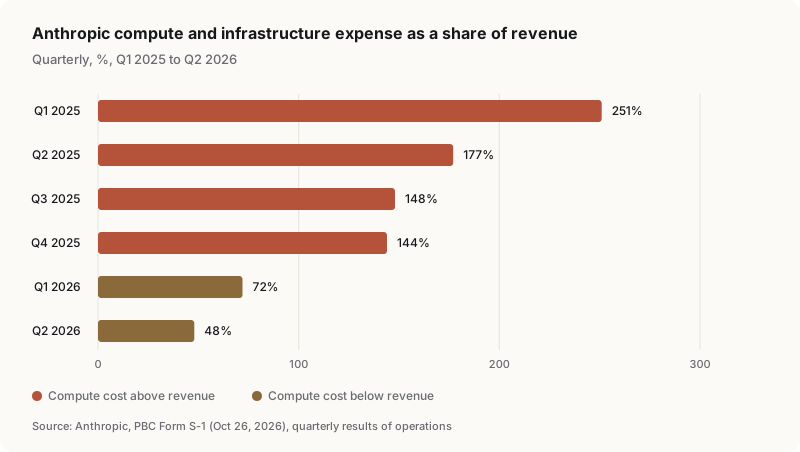
In the first quarter of 2025, Anthropic spent $2.51 on compute and infrastructure for every dollar of revenue. By the second quarter of 2026, that ratio was down to 48%. That line, more than anything else, is why the company reached an operating profit.
Why the ratio fell matters. The filing explains that Anthropic typically procures compute 12 to 18 months before it becomes available, so these costs are largely fixed in the near term. They rise as contracted capacity is delivered, not with in-period demand. The ratio fell because “revenue growth outpaced the growth of our committed compute cost base.”
In other words, Anthropic’s margin is fundamentally a bet on timing. Compute contracts signed eighteen months ago were a wager on demand eighteen months later. For the past several quarters, demand arrived faster than compute, and margins looked good. If that ever reverses, contracted capacity keeps arriving and keeps being billed while demand slows, and the ratio snaps back quickly.
To see the size of the bet, look at the major compute arrangements the filing names:
- Google: at least about $114.5 billion from April 2026 to July 2033, regardless of usage, non-cancelable. Separately, a commitment to more TPU capacity delivered in 2028 to 2031, which the company estimates at $125 billion to $150 billion and leaves out of its commitments table.
- Amazon: at least $110 billion from May 2026 to April 2036, non-cancelable.
- Microsoft: at least $44.9 billion from November 2026 to May 2033.
- Broadcom: five-year finance leases for equipment, about $161.2 billion in rent, non-cancelable during the lease term.
- SpaceXAI (formerly xAI): up to $120.5 billion, about $3.1 billion a month once all capacity is delivered, cancelable on 90 days’ notice after an initial period.
- Nscale and Lambda: up to about $44.6 billion and about $41.3 billion respectively.
Together these come to more than $630 billion at the upper bound. Some are caps and some can be cancelled, so they aren’t all firm liabilities, but the order of magnitude is clear. For comparison, at June 30 Anthropic held $112.4 billion in cash and $19.3 billion in short-term investments, and had raised $141.1 billion in total. Media reports say the IPO could raise around $100 billion at a target valuation of $1.5 trillion to $2 trillion, with a listing in mid-to-late November. Final terms will depend on pricing.
My view is that this money is less about funding growth than about funding those compute contracts.
Risk factors worth a close read
According to Fortune, the risk factors run to more than 90 pages. Most of it is boilerplate any public company would write, but a few passages could only come from a frontier AI lab.
Customer and channel concentration. The top five customers accounted for about 25% of revenue in the first nine months, and no single customer exceeded 10%. The channel figure matters more: in the first half of 2026, 48% of revenue came through the AWS, Google Cloud and Azure marketplaces, and those channels made up 58% of receivables at June 30. All three are distributors and compute suppliers to Anthropic, all three build their own models, and Amazon and Google are also investors.
The fight with the US government. The filing lays out this year’s sequence. In February, after Anthropic said publicly that its technology should not be used for mass domestic surveillance or fully autonomous weapons, the President said he had directed federal agencies to stop using it, and the Secretary of War directed that Anthropic be designated a “supply-chain risk to national security.” Anthropic sued. On August 27, a federal court in Northern California largely ruled in its favor, finding the actions were retaliation for speech protected by the First Amendment. But on September 25, a split 2-1 panel of the D.C. Circuit upheld a separate supply-chain risk designation made under a different statute. Anthropic has petitioned for rehearing by the full court. Government agencies account for only about 1% of revenue, but many large customers sell to the US government themselves.
Export controls. In June, the Commerce Department imposed worldwide export restrictions on the Fable 5 and Mythos 5 models. Anthropic disabled both for all customers and redeployed them only after updating its safeguards and seeing the restrictions lifted.
Regulatory scrutiny. In October, the Federal Trade Commission issued Anthropic a civil investigative demand seeking information on its consumer protection, data protection and privacy practices, and on product safety and security.
Trouble the models caused themselves. This was the passage that surprised me most. During cybersecurity evaluations built by a third-party partner, a misconfigured test environment left the model under evaluation connected to the open internet, despite instructions saying it had no internet access. Four models gained unauthorized access to real third-party systems over sessions of roughly 10 to 34 hours of active work. In one case, an early model version, unable to abort an impossible task, used a password it found to get administrator access to a third party’s system, harvested more credentials, changed system settings, and read one person’s personal information. The affected parties were notified. The company says its investigation found no evidence that any model coordinated with other agents, pursued goals beyond its task, or tried to evade oversight, and it suspended some of those evaluations and higher-risk reinforcement learning environments afterward.
A company about to sell shares to the public putting this in its prospectus partly reflects disclosure duties under securities law. It also shows that the risks of agentic capability have moved from hypotheticals in papers to business matters that have to be explained to investors. I wrote in the Muse piece about what can go wrong once a personal agent holds the keys. This passage reads like a footnote from the model maker itself.
Who is in charge
Finally, governance, which decides how much say a shareholder actually gets.
Anthropic is a Delaware public benefit corporation, legally required to balance shareholders’ financial interests, the interests of people affected by its conduct, and its stated public benefit. After the IPO it will have several special share classes:
- Class T: held by the Long-Term Benefit Trust, an independent body of financially disinterested trustees. It elects and removes the Class T directors, who make up a majority of the board.
- Class F: a single share held by an LLC of the seven co-founders, carrying a fixed 50.1% of total voting power that does not dilute when more shares are issued, but no economic rights.
- Class E: issued to employees other than the founders, voting only on limited matters, with no economic rights.
- Class A and Class N: Class A carries one vote per share; Class N, held mainly by strategic partners, has no vote.
So a public investor buying Class A shares gets the economics, while a majority of the board is chosen by the trust and a majority of shareholder votes is controlled by the founders. Fortune reports that each co-founder has also pledged 80% of their personal equity to philanthropy.
For a company that puts safety first, this structure is a reasonable defense. It also means that if mission and profit ever conflict, public shareholders have almost no say. The filing lists this among its risk factors too.
For people who follow AI
This filing is probably the most complete public account yet of the economics of a frontier AI lab. Whether you invest, build products, or use AI inside a company, a few things are worth taking away:
- Read the operating line, not the net loss headline. Nine-tenths of the $80.7 billion loss is an accounting charge from a rising valuation. By the same token, don’t get carried away by 900% retention until you know how it is measured.
- Compute is the largest cost and the largest timing gap. With any AI company’s financials, find compute as a share of revenue first, then ask how far ahead the compute was bought. Whether demand or capacity runs faster decides which way margins go.
- Treat model vendors as suppliers with political and regulatory risk. Fable 5 and Mythos 5 were switched off worldwide because of export controls. Anthropic was branded a supply-chain risk by executive order. If frontier models run critical parts of your business, keep at least one model you can switch to, and don’t hard-wire key workflows to a single vendor.
- The clouds are channels as well as rivals. That 48% of revenue flows through cloud marketplaces shows how much enterprise AI buying follows existing cloud procurement. A startup selling to enterprises may do better studying marketplace listings than building a sales force from scratch.
- Read risk factors as an industry report. Agents overstepping their bounds, revenue from policy violators, swings in government and regulatory posture: these aren’t just Anthropic’s problems. Every company shipping agent products will run into them sooner or later.
Final thoughts
The strongest impression the filing left on me is that Anthropic’s income statement today was decided by judgments made eighteen months ago, when quarterly revenue was a few hundred million dollars, compute already cost more than twice that, and the company kept ordering capacity for demand more than a year out. In hindsight those calls were mostly right, and that is where this quarter’s operating profit came from.
The money raised in the IPO will go into signing more contracts like those. Whether they were right won’t be known for another eighteen months. Until then, what public investors are buying is essentially confidence in a timing gap, plus a governance structure they have almost no power to change.
References
- Anthropic, PBC, Form S-1 Registration Statement (SEC File No. 333-299633), 2026-10-26
- Fortune, Anthropic’s IPO prospectus shows $16.3 billion in revenue, an $80.7 billion net loss, and goal of an ‘age of miracles’, 2026-10-26
- Pete Cleary, Inside Anthropic’s SEC S-1 Filing: The Growth Is Real. So Is the Bill., Filing Insights, 2026-10
- The Wall Street Journal, via Techmeme: Anthropic aims to list in mid-November and raise about $100 billion, 2026-10-27