
41 Votes, 40 Noes: American Voters Push Back on Data Centers, and the Nasdaq Falls 5.5% in a Day
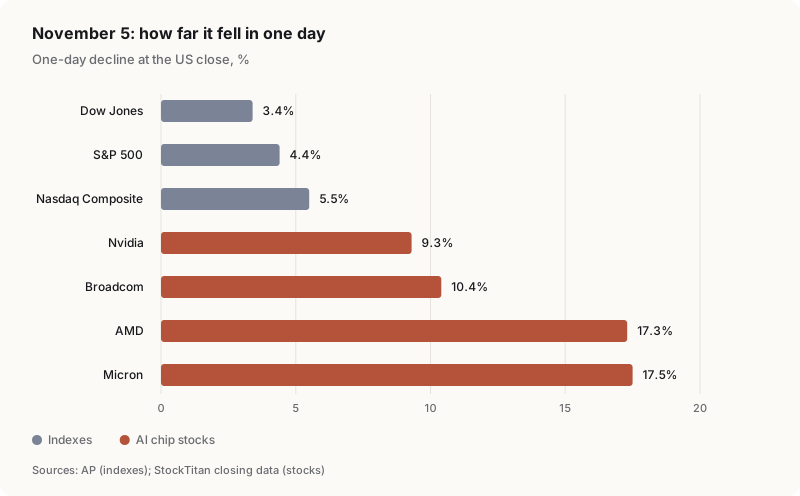
On Thursday, November 5, the S&P 500 fell 4.4%, the Nasdaq Composite fell 5.5%, and the Dow dropped 1,833 points. According to the Associated Press, it was the S&P 500’s worst day since the “Liberation Day” tariffs of April 2025. It wiped out the previous day’s gain, which had been the index’s best in three months.
The hardest-hit companies were the ones tied to AI data centers. StockTitan’s closing figures show Nvidia down 9.3%, Broadcom down 10.4%, AMD down 17.3% and Micron down 17.5%. CNBC estimated that Nvidia alone lost nearly $450 billion in market value.
The AP put the cause in one sentence: after Democratic victories in the midterm elections, investors worried about possible moratoriums on data centers.
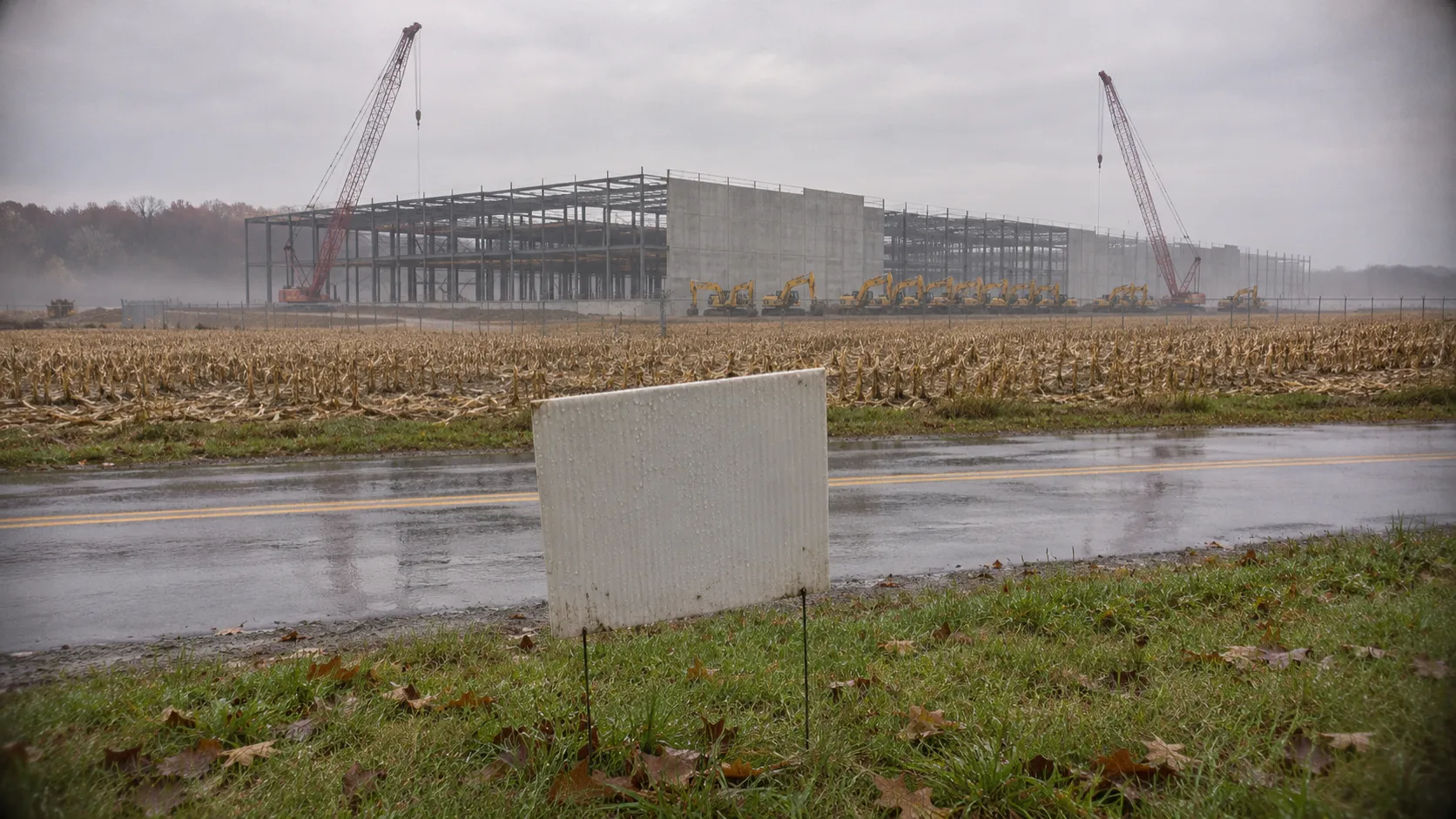
The story started two days earlier. On November 3, alongside races for Congress and governor, voters faced 41 local measures on data centers across 10 states. According to Ballotpedia’s count, cited by CNBC and Scientific American, voters sided with restrictions in 40 of them.
I want to work through four questions here: what voters were actually rejecting, how much of the market panic is justified, how far OpenAI’s next-day “community compact” really reaches, and what all of this means for the cost of compute and for people who build with AI.
41 votes, 40 noes
Start with the votes themselves. The 41 measures ranged from moratoriums to rezonings to advisory questions for local officials. Ohio alone accounted for 21 of them, more than half.
A few specific results:
- Wells, Maine. More than 80% of voters approved a retroactive 180-day moratorium on data center development.
- Harwood, North Dakota. The only result that went the other way. By roughly three to one, voters rejected a proposal to add extra review for industrial projects. According to Scientific American, a $3 billion data center is under construction nearby.
The races for governor and Senate got tangled up with data centers too. CNBC reported:
- Texas. Democrat Gina Hinojosa unseated Governor Greg Abbott, blaming him for the rapid buildout of data centers. Scientific American, citing a Wall Street Journal analysis, says Texas accounts for about a quarter of the US data center capacity in the works.
- Ohio. Democrat Amy Acton defeated Vivek Ramaswamy for governor. She supports a “conditional moratorium” requiring data centers to cover 100% of utility costs and build exclusively with union labor. In the Senate race, Sherrod Brown ousted Senator Jon Husted after casting him as “the face of data centers.”
- Georgia and Wisconsin. Democrats who campaigned on pausing or regulating data center projects also won.
In a CNBC voter poll, 56% of voters said data centers were a crucial or major factor in their decision.
One caveat on the numbers: 41 is the count for November 3 alone. Scientific American notes that six similar votes took place earlier this year, with three more still to come. That is why some outlets cite 50. Different scope, same direction.
What the market is afraid of
The logic linking the election to Nvidia’s share price is simple: if data centers get built more slowly, chips get sold more slowly.
Two people close to the business showed how real that link is:
- Dina Powell McCormick, Meta’s president, said at the WSJ Tech conference on November 4 that building data centers is “going to be harder.”
- Cristiano Amon, Qualcomm’s CEO, reported earnings on November 4, with $650 million of data center revenue in the quarter. “We don’t have a demand issue; it’s a supply issue,” he told CNBC. Qualcomm’s guidance for the current quarter disappointed, and its stock also fell more than 9%.
Still, I don’t think the whole drop was about the election, for two reasons.
First, the market was already on edge. As I wrote on November 1, Intel fell nearly 30% in a single day on October 30 and OpenAI reportedly cut its fundraising target. People were already asking where the money for AI would come from. StockTitan quotes Michael Cembalest of J.P. Morgan Asset Management, who wrote in a November 4 note that the recent AI selloff “appears influenced by a heavy bout of hedge fund profit-taking.” The election gave sellers a reason.
Second, near-term construction is largely locked in. StockTitan also relays J.P. Morgan’s estimates: of the roughly 37 gigawatts of data center capacity due in 2027, 75% is already under construction. The real exposure is 2028, when about 96 gigawatts are due, of which about 37.5 gigawatts may face a “pause” and another 15 gigawatts may face “conditions.”
My reading is that these votes don’t change 2027. They change the supply curve from 2028 onward. When Nvidia reports on November 17, what management says about order visibility for 2028 will matter more than one day’s decline.
One more detail that is easy to miss: in Texas, Democrats are not the only ones pulling back. According to StockTitan, Abbott himself directed the state’s environmental agency on September 21 to halt data center permits until an audit of grid connections was finished. Hinojosa doesn’t take office until January. The gate in Texas was already narrowing before anyone voted.
What OpenAI delivered the next day
On November 5, OpenAI released two documents: a National Community Compact and a Compute Campus Policy Blueprint. The timing makes it hard not to read them as a response to the election, although Chris Lehane, OpenAI’s chief global affairs officer, told CNBC that the blueprint had been in the works since August.
I read the compact itself. Its commitments for OpenAI’s own campuses come down to these:
- No NDAs with public officials. OpenAI will not require officials to sign NDAs as a condition for discussion or negotiation, with narrow exceptions for security information and trade secrets.
- Pay the full power bill. OpenAI will pay the full cost of the electricity it uses plus the incremental cost of grid infrastructure built to serve its sites, so that residents don’t foot the bill.
- Insure against stranded assets. Before major spending begins, it will provide financial assurances so other customers aren’t left with the costs if a project is delayed, reduced or canceled.
- Publish the data. Site-level water use, electricity use and economic impact will be published, along with independent noise studies before operations begin and every year after, measured at the property line and in neighboring areas.
- Step back at peak demand. OpenAI will cut consumption when the grid is stressed. The compact’s example is Effingham, Georgia, where Georgia Power can reduce delivery to the campus by up to 1,000 megawatts during high demand.
- A local compact for every site. Each campus gets its own locally tailored compact, with annual public reporting.
On paper, that is a serious list. But three things deserve attention.
First, scope. The compact repeatedly says it applies to future campuses “owned and operated by OpenAI.” A lot of OpenAI’s compute is built by partners and leased. Take the PORTS-Pike campus in Ohio, where CNBC says OpenAI secured 8 gigawatts of capacity. As MLQ points out, SB Energy builds, owns and operates that campus, and OpenAI is a customer, so the compact may not reach it.
Second, the NDA pledge tells you NDAs existed. The blueprint contains this sentence: “In July, we voided NDAs in Effingham.” In other words, on the Georgia project, OpenAI had public officials sign NDAs. That style of negotiation, where officials know and residents don’t, is probably exactly what voters resent most.
Third, the first test has already arrived. Local station WTOC reported that on November 4 the Effingham County commissioners voted unanimously to table the site plan until November 17. They still had questions about wetlands, earthen berms, power demand and cooling water. One resident told the board: “Until y’all start being transparent, until y’all can start answering some questions, I’m going to be up here each and every week.” This is the very project the compact holds up as its model.
The blueprint asks for laws
The blueprint is the more interesting document. Beyond describing what OpenAI will do, it asks governments to turn similar requirements into law: ban developers from requiring NDAs of officials, mandate disclosure of noise, water, energy and economic impacts, make large customers pay the grid costs they create, publish discretionary tax incentives, and add clawbacks when commitments aren’t met.
One line is unusually blunt: “voluntary measures alone don’t meet the scale of this moment or provide durable confidence to communities.”
A company asking to be regulated sounds odd. My read is that this is part conviction and part strategy:
- Uniform rules level costs. If only OpenAI pays for grid upgrades and publishes its data, it is more expensive than competitors who don’t. Put it in law and everyone pays.
- Writing the rules beats receiving them. The new Congress convenes in January. Lehane told CNBC that having these conversations now means that “when people come back in late January, new Congress is in in session, a lot of the work is being done in advance.” He said he had met with dozens of lawmakers and candidates.
- It also draws the boundaries of opposition. The blueprint explicitly opposes blanket requirements that large customers build their own power. And OpenAI’s stance on moratoriums is clear: TechCrunch reports that in a recent essay, Lehane warned that moratorium supporters could jeopardize America’s lead over China, comparing that position to the 2002 vote authorizing the Iraq war.
There are critics, too. Kate Brennan of the AI Now Institute told TechCrunch: “This is written by a private company that is trying to advocate for policies for its own benefit.”
I think both things are true. These are the terms residents want. And when OpenAI drafts the rules, the boundaries will naturally fall where OpenAI can live with them.
What this means for people who follow AI
This happened in America, but I think there are lessons that travel.
- The bottleneck has moved from chips to permission. For two years the question was whether there were enough GPUs and enough power. This election adds another layer: whether the people who live nearby agree. When Amon talks about a “supply issue,” supply now includes whether a county board will vote yes, not just foundry capacity.
- Data centers will cost more. Full grid costs, stranded-asset guarantees, independent noise studies and community investment all cost money. In Effingham County alone, OpenAI has committed $80 million to community priorities, and $40 million in Pike County. That money ends up in the price of compute. Teams that rely on API access from US cloud providers shouldn’t assume prices will keep falling at the old pace.
- Capacity in 2028 is less certain than in 2027. If your product plan depends on cheap, abundant inference two years from now, line up at least two providers and invest in model efficiency rather than waiting for hardware to get cheaper.
- Transparency is the cheapest PR. Signing NDAs in Effingham and then voiding them cost OpenAI far more than disclosing up front would have. Anyone building compute centers or courting them for a region faces the same questions: who pays for the power, where the water comes from, how loud it is, what residents get. Putting those on the table early is cheaper than fixing things later.
- Watch Nvidia on November 17, and Texas in January. The first tells you whether orders are wobbling. The second tells you whether the biggest data center state in the country actually hits the brakes.
Final thoughts
Before this election, the AI industry talked about data centers almost entirely in engineering terms: how many gigawatts, how many GPUs, when the power comes on. Voters used a different vocabulary: will my bill go up, is there enough water in the well, how loud is it at night, and what did the officials and the company agree to behind closed doors.
Forty noes out of 41 votes doesn’t mean Americans are against AI. What they rejected was a way of building that didn’t ask them. OpenAI’s compact, released the very next day, shows the industry heard the message. What comes next is whether those promises hold in places like Effingham, and whether they extend to the campuses that partners build.
References
- Associated Press (via WTOP), How major US stock indexes fared Thursday 11/5/2026, 2026-11-05
- CNBC, AI meltdown: Nvidia and Qualcomm drop more than 9%, pushing Nasdaq to worst day since April 2025, 2026-11-05
- StockTitan, Why AI Stocks Are Down Today and Why the Whole Market Followed, 2026-11-05
- CNBC, Voters rebuff data centers in every ballot measure except one during the 2026 midterms, 2026-11-04
- Scientific American, 2026 election results show widespread opposition to AI data centers, 2026-11-04
- OpenAI, OpenAI’s National Community Compact: Building With Communities, Not Just In Them, 2026-11
- OpenAI, AI Infrastructure That Works for America: Our Compute Campus Policy Blueprint, 2026-11
- CNBC, OpenAI pledges to halt NDAs in new data center policy proposal after election rebuke, 2026-11-05
- MLQ, OpenAI promises to pay campus power costs and end public-official NDAs after data center backlash, 2026-11-05
- WTOC, Effingham County delays vote on OpenAI data center site plan, 2026-11-05
- TechCrunch, OpenAI is already trying to shape the 2028 election, 2026-11-04
- The National, OpenAI promises to listen to communities on data centres after election result, 2026-11-05