
Intel loses nearly 30% in a day, OpenAI trims $10 billion: the AI bill reaches private markets
US markets closed at 4 p.m. Eastern on Friday, October 30. Intel had fallen 28.58% on the day, its biggest one-day drop since 1974 according to CNN. The Philadelphia Semiconductor Index lost 7.2%, the Nasdaq Composite 2.86% and the S&P 500 1.82%, both broad indexes posting their worst session since June.
A few hours later, the Financial Times reported that OpenAI had cut the target for its current funding round from $30 billion to about $20 billion. The FT also reported that Blackstone, which anchors a chip financing deal for Anthropic, had told investors it now expects Anthropic’s post-IPO credit rating to land in the top tier of junk.
On October 29 I wrote, in Cloud revenue doubled, the stock fell 10%, that Wall Street had started asking where the money for AI comes from. Back then the question was about one company’s cash flow statement. Two days later it had spread from earnings reports to chip stocks, and by that same evening to OpenAI and Anthropic, neither of which is public yet.
I want to work through three things here: what happened during the week; whether the market is doubting AI demand or something else; and what this means for people who build and use AI.
A week of knock-on effects
Here is the sequence, all times US Eastern.
- Wednesday, October 28, after the close. Microsoft and Alphabet reported. Google Cloud revenue grew 103% and Azure 48%, but Alphabet’s third-quarter free cash flow was negative $9.1 billion, its second negative quarter in a row.
- Thursday, October 29. According to TechCrunch, Alphabet fell 12%, its worst day on record, erasing about $500 billion in market value. After the close, Amazon, Intel and Reddit reported.
- Friday, October 30. Intel fell 28.58%. Reddit fell 29.22%, for reasons I covered in On the same evening, Amazon and Reddit pulled the door half shut. Chip stocks fell across the board: Qualcomm 11.12%, AMD 10.88%, Nvidia 4.22%. CoreWeave and Nebius, which rent out compute, dropped 9.66% and 10.38%.
- Friday evening. The FT reported OpenAI’s lower target, and Blackstone’s lower expectations for Anthropic’s rating.
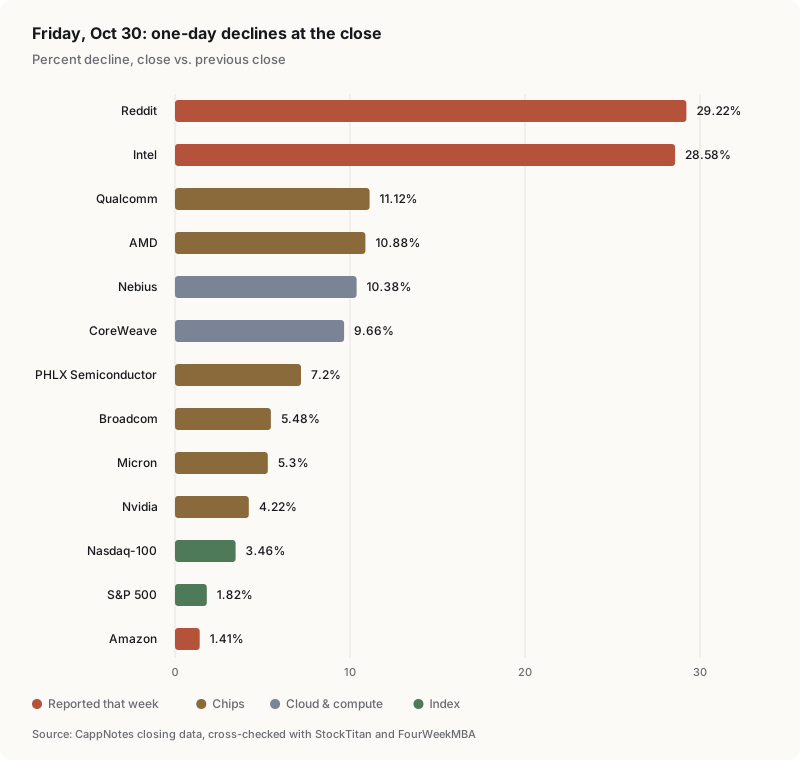
This did not happen in a single day. CoinDesk, relaying the FT, reported that the Nasdaq-100 had fallen about 10% in three weeks from its October 6 record. FourWeekMBA, citing Reuters, said the chip index lost more than 15% over October.
Amazon is worth a separate note. TechCrunch reported it fell 7% in after-hours trading on Thursday; by Friday’s close it was down only 1.41%, having recovered most of that. Intel barely bounced. The difference between the two comes up below.
Intel’s fall was not about AI
Read only the headlines and you might conclude that AI chips are in trouble. But in Intel’s October 29 earnings release, AI was the best part:
- Third-quarter revenue of $16.5 billion, up 21%. Non-GAAP gross margin of 44.1%, up 4.1 points.
- Data center and AI revenue of $7.3 billion, up 78%. CFO David Zinsner called it the company’s strongest data center revenue growth in 15 years.
- Foundry revenue of $6.7 billion, up 58%.
- PC revenue of $8.1 billion, down 5%.
What sank the stock was fourth-quarter guidance: revenue of $15 billion to $16 billion, below the third quarter; non-GAAP gross margin of 38.0%, six points lower; non-GAAP earnings per share of $0.25. According to LSEG figures cited by StockTitan, analysts had expected $17.1 billion in revenue and $0.43 per share, so the midpoint was about 9% short.
Zinsner gave a single sentence of explanation in the release: “Looking ahead, we see the PC slowdown continuing at least through the first half of next year.”
So the direct cause was PCs and margins, not AI. Yet Intel was far from the only stock that fell on Friday. Qualcomm, AMD, Broadcom, Micron and Nvidia all dropped, however much or little they depend on the PC market. My read is that the market was not parsing each report that day. It was looking for a reason to cut its exposure to the whole AI hardware chain, and Intel supplied one.
The doubt is about cash, not demand
Put the week’s numbers side by side and the demand column is almost all good news:
- Google Cloud revenue up 103%.
- Azure up 48%.
- AWS revenue of $46 billion, up 39%, which Amazon’s release called its “fastest growth in nearly five years.”
- Intel data center and AI up 78%.
The cash column looks different. By TechCrunch’s tally, Alphabet, Amazon, Meta and Microsoft laid out capex plans over the past two weeks totaling more than $740 billion for this year. Amazon reiterated full-year capex of about $220 billion and spent $77.3 billion on property and equipment in the third quarter alone. Its trailing twelve-month free cash flow was negative $42.4 billion, against positive $14.8 billion a year earlier; the release says the decline was “driven primarily by a year-over-year increase of $94.8 billion in purchases of property and equipment.” Meta’s third-quarter free cash flow was negative $2.1 billion. Of the four, only Microsoft was positive, at $18.6 billion for the quarter.
When cash runs short, companies borrow. TechCrunch, citing S&P Global Market Intelligence, reported that Microsoft, Alphabet, Amazon, Meta and Oracle have raised a combined $326 billion in debt this year, three times last year’s total.
My view is that the market this week was not doubting whether people use AI. It was doubting two other things: how long before this spending comes back as cash, and who pays in the meantime. I think Amazon recovered most of its losses on Friday because AWS’s growth and profit are solid enough, with $17.8 billion in third-quarter operating income, that investors were willing to give it more time. Intel has no such cushion. Its AI business cannot yet carry the whole company’s profits.
OpenAI’s $20 billion
Private markets reacted faster than many people would expect.
Some background on the round first. According to TechCrunch, OpenAI closed a $122 billion round in March at an $852 billion post-money valuation. On September 29, Bloomberg reported it was in talks to raise at least $30 billion at roughly $1.4 trillion, a bridge round ahead of an IPO; CEO Sam Altman had ruled out going public this year. On October 22, CNBC reported the target as up to $30 billion at a $1.25 trillion pre-money valuation, led by Coatue and investors from the UAE.
The FT’s October 30 report lowered the target to about $20 billion, still at $1.25 trillion. The first close is expected to come in below $20 billion, the FT said, and a later offering to wealthy individuals could bring the total up to the target. Briefs, relaying the FT, listed the planned participants as the UAE’s state-backed MGX, SoftBank, Sequoia Capital, Coatue, Founders Fund and Andreessen Horowitz. TechCrunch, relaying the Wall Street Journal, reported that OpenAI has secured $11 billion so far and that some large investors gave it a “tepid” response. OpenAI did not comment on the reports.
The FT gave two reasons: the market selloff and competition from Anthropic, which plans to go public next month at a valuation of no less than $1.5 trillion, according to the FT.
A detail the headlines tend to bury: even $1.25 trillion is nearly 50% above March’s $852 billion. This is not a down round. What changed is not the price but the number of people willing to pay it. Going from $30 billion to $20 billion means a third of the money did not show up.
To me, this is what a cooling private market usually looks like. Valuations hold first. What moves first is how much gets subscribed, how fast it closes and who is on the list. Price is often the last thing to change.
There is another layer. Anthropic will be raising a very large sum on public markets next month, around $100 billion according to earlier media reports. Only so many institutions can write checks in the tens of billions. Asked in the same month to join an OpenAI private round and an Anthropic IPO, many of them will pick one, or take less of both.
Anthropic’s rating and borrowed compute
The other story got less attention, but I think it deserves more.
TechCrunch, relaying the FT, reported that Blackstone is the anchor investor in a $63 billion chip financing deal for Anthropic. Blackstone had expected Anthropic to reach an investment-grade rating before 2027. It now tells investors it expects a rating “in the double B range” after the IPO, the top tier of junk. Anthropic and Blackstone declined to comment.
In An $80.7 billion loss, and an operating profit, I noted that the compute purchase commitments in Anthropic’s S-1 add up to more than $630 billion at the upper end. That cannot all be funded with equity; some of it has to be borrowed. The rating sets the cost of that borrowing: the rate gap between investment grade and junk can be meaningful, and so is the difference in which institutions are allowed to buy the bonds. TechCrunch’s assessment was that without investment grade, Anthropic would lean more on cloud providers and third parties to fund its infrastructure.
Put these pieces together and you get a long chain:
- Big tech’s operating cash flow does not cover its capex, so it issues debt and new shares;
- Model companies’ revenue does not cover their compute contracts, so they raise equity and debt;
- Chipmakers and compute rental companies earn much of their revenue from what the first two spend;
- Every link is pledging future revenue to pay for what gets built today.
Reprice one link and the others move with it. On Friday CoreWeave and Nebius fell further than Nvidia. As I see it, that is because they sit at the link that borrows to build data centers and relies on long-term contracts to pay it back, the part of the chain most exposed to rising financing costs.
For people following AI
- Separate demand from financing. This week’s numbers show AI demand still accelerating, with cloud growth the fastest in years. What is under strain is the pace and structure of payment. When you see an “AI bubble bursts” headline, first ask which layer it is talking about.
- If you’re building an AI startup, plan your runway now. If even OpenAI is raising a third less, caution in private markets will reach later stages within months, and early stages after that. My suggestion: don’t build a budget on the assumption that the next round doubles your valuation, plan cash for at least 18 to 24 months, and remember that revenue quality persuades investors more easily than growth rate.
- If your team depends on model APIs, keep an alternative ready. As financing gets more expensive for model companies and cloud providers, subsidized pricing, free tiers and generous usage limits become more likely to tighten. That is my guess, not any company’s stated plan. Track the cost of each task, and have a second model ready for critical workflows. It is much cheaper than migrating in a hurry.
- Chinese AI valuations have an overseas anchor. Chinese model and compute companies that are listed or heading for listings are often priced against their overseas peers. If that anchor slips, domestic valuations are unlikely to be spared.
- Three signals worth watching in the coming weeks. First, Anthropic’s final IPO pricing and demand. Second, how large OpenAI’s first close actually is. Third, the interest rates on new bonds from big tech and model companies. These three numbers say more than any single day’s stock moves about how much, and at what price, the market is willing to front for AI’s future.
Final thoughts
A week ago the market was cheering cloud revenue that had doubled. This Friday made something else clear: it took little more than a day for an earnings report to move a stock, and then a private round that hasn’t even closed.
I don’t think this means AI isn’t useful. Almost every demand number says it is becoming more useful. The problem is that years separate a finished data center from the cash it eventually returns, and someone has to pay the bill in between. Until now everyone assumed that someone would always be there. This week, for the first time, the market seriously asked: what if they put in a little less?
We will start to find out in November.
References
- Intel, Intel Reports Third-Quarter 2026 Financial Results, 2026-10-29
- Amazon, Amazon.com Announces Third Quarter Results, 2026-10-29
- TechCrunch, Cracks are emerging in the AI spending boom, 2026-10-30
- TechCrunch, OpenAI reportedly lowers funding target for new round, 2026-10-31
- TechCrunch, Anthropic expected to receive high-junk rating from credit agencies following IPO, report says, 2026-10-30
- TechCrunch, OpenAI working on new $30B raise at $1.25T valuation ahead of IPO, 2026-10-22
- TechCrunch, OpenAI reportedly in talks to raise $30B round at $1.4T valuation, 2026-09-29
- CoinDesk, OpenAI reportedly cuts fundraising target amid AI jitters, 2026-10-30
- Briefs, OpenAI trims funding goal by $10 billion as AI jitters hit markets, 2026-10-31
- StockTitan, Stock Market Today October 30, 2026: Tech Stocks Fall as Intel Has Its Worst Day in Decades, 2026-10-30
- CappNotes, Closing Look — Friday, October 30, 2026, 2026-10-30
- FourWeekMBA, Apple passes Nvidia at $5.03 trillion as chip stocks slide, 2026-10-30
- TechCrunch, As search traffic dries up, Reddit announces it’s shifting to a logged-in experience, 2026-10-29