
Cloud revenue doubled, the stock fell 10%: Wall Street starts asking who pays for AI
After the US market closed on October 28, Microsoft and Alphabet reported quarterly results within minutes of each other.
Cloud was the headline in both. Google Cloud brought in $30.7 billion in the third quarter, up 103% from $15.2 billion a year earlier. Microsoft’s Azure brought in $33.2 billion, up 48%, faster than the 42% of the previous quarter and ahead of the roughly 45% analysts expected. Both companies met or beat expectations on revenue and profit.
The stocks went opposite ways. Microsoft rose after hours: Fortune put the gain at about 2.5%, CNBC’s headline said 4%, depending on when they checked. Alphabet fell more than 10% at one point, wiping out more than $280 billion in market value by Fortune’s count.
The company whose cloud revenue doubled lost a tenth of its value; the company whose cloud grew 48% went up. After reading the two cash flow statements side by side, I don’t find that surprising. What the market priced that evening was not whether there is demand for AI. It was who is paying the bill.
Two report cards, one evening
The numbers first.
Alphabet (third quarter, ended September 30):
- Revenue of $127.6 billion, up 25%. In the press release, Sundar Pichai said the company is now on “a half-trillion dollar revenue run rate.”
- Google Cloud revenue of $30.7 billion, up 103%. Operating income rose from $3.6 billion a year ago to $11.1 billion, a 36.2% margin. The company said TPU system sales were “a meaningful contributor” to growth.
- Search revenue of $63.4 billion, up 12%. Per Fortune, growth was 19% in the first quarter and 17% in the second; analysts had expected 15% this time.
- Earnings per share of $2.12, down from $2.87. The main reason was an $8.7 billion paper loss on equity investments, which cut EPS by $0.55.
Microsoft (first quarter of fiscal 2027, also ended September 30):
- Revenue of $92.3 billion, up 19%; net income of $36.6 billion, up 32%.
- Azure revenue of $33.2 billion, up 48%. Microsoft Cloud as a whole brought in $63.9 billion, up 30%.
- Commercial remaining performance obligation (contracted revenue not yet recognized) of $677 billion, up 73%.
On these numbers alone, Alphabet’s cloud looks better. The trouble is in the tables further down.
The difference is cash, not growth
Alphabet spent $51.4 billion on property and equipment in the third quarter, mostly servers and data centers. A year earlier it spent $24 billion. Operating cash flow in the same quarter was $42.3 billion, lower than the $48.4 billion of a year ago.
When you spend more than you bring in, free cash flow goes negative: minus $9.1 billion in the third quarter. It was the second negative quarter in a row, after minus $5.9 billion in the second.
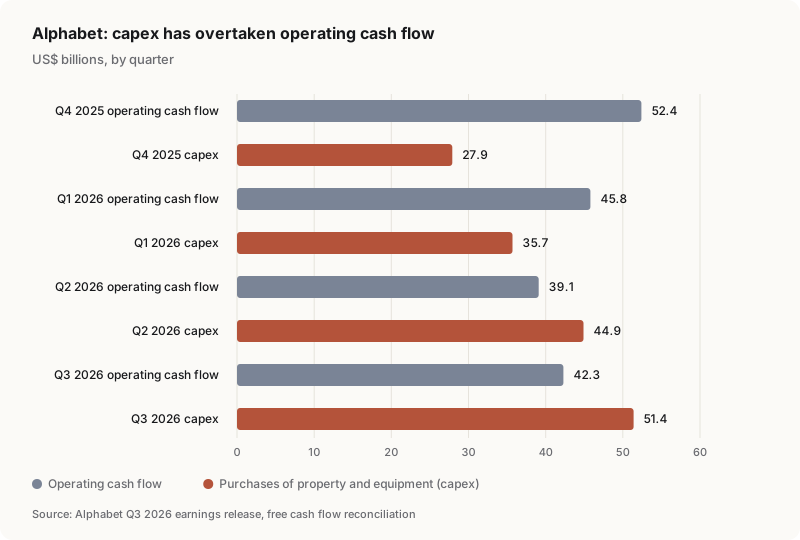
Across these four quarters, capex nearly doubled from $27.9 billion to $51.4 billion, while operating cash flow fell from $52.4 billion to $42.3 billion. On the call, the company said two more things weighed on cash this quarter: building up inventory for TPU system sales (inventory on the balance sheet went from $2.4 billion at the end of last year to $13.3 billion) and a $5.2 billion cash payment for a 2018 European Commission fine now that the appeal is over. Neither happens every quarter. But even adding back the fine and the $3.2 billion inventory build this quarter, free cash flow is still negative.
So where is the money coming from? The financing section spells it out. In the first nine months of 2026:
- Buybacks were zero. In the same period of 2025, Alphabet bought back $39.8 billion of stock.
- It raised $42.9 billion, net, by selling common stock, including $12.4 billion from 36 million shares sold in the third quarter through an at-the-market program, which still had $27.6 billion of capacity left at the end of September.
- It raised $19.1 billion from mandatory convertible preferred stock.
- It raised $85.2 billion in new debt. Long-term debt went from $46.5 billion at the end of last year to $125.1 billion.
A company that spent years returning cash to shareholders through buybacks is now asking shareholders for cash. Independent analyst Luke Lango put it bluntly to Fortune: Alphabet is “now funding the AI buildout with shareholders’ money instead of its own cash.”
And spending hasn’t peaked. Guidance for 2026 capex stays at $195 billion to $205 billion, and CFO Anat Ashkenazi said on the call that the company expects capex to “increase significantly in 2027,” with details on the fourth-quarter call. Outside estimates for 2027 range from $250 billion to more than $300 billion. The company has not given a number.
Why Microsoft got a pass
Microsoft is spending heavily too. Cash capex was $39.4 billion this quarter, more than double the $19.4 billion of a year earlier. Including finance leases, CNBC and Fortune report $45.2 billion. These are two different measures; it’s worth checking which one a report uses.
The difference is that Microsoft still returned $10.2 billion to shareholders through dividends and buybacks this quarter, and CFO Amy Hood said she expects free cash flow to stay positive in fiscal 2027, which ends next June. Alphabet hasn’t bought back a single share this year.
One detail deserves a closer look. Microsoft’s capex came in below expectations: per StreetAccount data cited by CNBC, analysts had expected about $50.7 billion. Hood was clear about why: some expected third-party capacity deliveries were delayed. She also said, “We still have demand that exceeds supply.” Her guidance for next quarter’s capex is more than $50 billion.
My read is that part of what the market rewarded this quarter was Microsoft spending less than expected, and it spent less because someone else delivered late, not because it chose to hold back. The real test has moved to next quarter.
Go back one more week. On October 21, Meta reported third-quarter capex, including finance lease principal, of $34.9 billion, more than its $32.8 billion of operating cash flow. Free cash flow was minus $2.1 billion, and the stock fell about 7% the next day.
Three companies, one pattern: the ones whose free cash flow turned negative were punished; the one that can still pay for its own buildout got a pass.
Alphabet’s drop isn’t only about cash
To be fair, Alphabet fell that evening for more than one reason.
The first is Search. Pichai stressed in the release that year-over-year Search query growth is “the highest it’s been in the last five years,” including commercial queries. Yet Search revenue growth slowed from 19% at the start of the year to 12%, below expectations. Queries growing fast while revenue grows slowly could mean ads in AI answers don’t yet monetize as well as the classic results page. That’s my guess, not something the company said, but the market is clearly worried about it. As Aptus Capital’s David Wagner told Fortune: Cloud did its job, “the problem is everything else.”
The second is the $8.7 billion paper loss. Lango called it “accounting noise.” It doesn’t touch cash, but it dragged EPS down and made the headline ugly.
The third is cash flow. But I’d argue the first two were magnified precisely because of the third. If Alphabet still had the cash cushion it had two years ago, the market would likely be patient with slower Search growth. Today, Search is the main source of cash feeding the AI buildout, and when that source slows, everything gets tighter.
Who signed the $561 billion backlog?
Whether cloud growth lasts depends on the contracts already signed.
Per the call, Google Cloud’s backlog reached $561 billion, and management expects just over 55% of it to turn into revenue over the next 24 months. Microsoft’s commercial remaining performance obligation stands at $677 billion. Demand is real, and it’s in writing.
But it’s worth asking who signed those contracts.
When I wrote about Anthropic’s S-1 earlier this week, I noted that Anthropic has committed to buy at least about $114.5 billion of compute from Google between April 2026 and July 2033, regardless of usage and non-cancellable, and at least $44.9 billion from Microsoft between November 2026 and May 2033 (see “An $80.7 billion loss, and an operating profit”). The S-1 doesn’t say how much of Google’s backlog that represents, and Alphabet doesn’t break it out, so I can’t give a share. What is clear is that a sizable part of cloud backlogs comes from AI companies that are themselves losing money and growing on raised capital.
That makes a chain. Alphabet sells stock and bonds to build data centers and sells compute to model companies like Anthropic. The model companies pay their compute bills with money from funding rounds and IPOs. And Alphabet is also an Anthropic investor. Every link is growing, but each link’s cash comes from the next link’s fundraising. As long as capital markets keep writing checks, the chain turns. I read last night’s stock reaction as the market reminding everyone that its checks come with conditions.
For people who follow AI
Whether you invest, buy AI inside a company, or build AI products, here is what I’d take from that evening:
- For cloud businesses, read the cash flow statement first. Cloud revenue growth signals demand; free cash flow signals sustainability. No matter how fast a cloud grows, if capex keeps running ahead of operating cash flow, the company will eventually have to trade off growth, margins and shareholders.
- Check the capex definition. Microsoft has both $39.4 billion and $45.2 billion for the same quarter, and Meta’s figure includes finance lease principal. Before comparing companies, make sure the numbers measure the same thing.
- Backlog is not revenue. Look at the conversion pace (Google says just over half within two years), and ask who the customers are. If the biggest ones pay with raised money, backlog quality is tied to capital market sentiment.
- The compute crunch isn’t over. Microsoft itself says third-party deliveries are late and demand exceeds supply. Teams that depend on cloud AI compute for critical work should have a second provider or fallback model, and shouldn’t assume capacity is always available.
- One more report tonight. Amazon reports after the US close on October 29. According to Pepperstone’s earnings preview, its 2026 capex plan has already been raised to about $220 billion. I’ll be watching AWS growth and whether free cash flow stays positive.
Final thoughts
Two years ago the worry was that nobody would use AI and the cloud giants would never earn back what they spent. Last night’s reports largely settled that: Google Cloud doubled, Azure accelerated, and the two companies’ backlogs together top a trillion dollars. The demand is real.
The new question is about time and money. Data centers have to be built and chips bought first, while revenue arrives over the next two years. In between, someone has to front the cash. It used to be these companies’ own profits. Now Alphabet and Meta have started using shareholders’ and lenders’ money. Last night’s stock moves were shareholders’ first verdict on being the ones who front it.
I don’t think this shows AI spending is a bubble. It shows AI has moved from a story about demand to a story about cash. Over the next few quarters, the companies that can pay for their compute with money they earn will pull away from the ones that keep having to raise it.
References
- Alphabet Inc., Alphabet Announces Third Quarter 2026 Results (press release and financial statements), 2026-10-28
- Microsoft, FY27 Q1 Press Release (Microsoft Investor Relations), 2026-10-28
- Meta Platforms, Meta Reports Third Quarter 2026 Results, 2026-10-21
- Fortune, Alphabet’s Google Cloud revenue doubles to $31 billion as cash flow stays deep red, 2026-10-28
- Fortune, Microsoft’s cloud growth accelerates, and so too does the spending, 2026-10-28
- CNBC, Alphabet sinks 10% as it holds 2026 capex unchanged, expects significant increase in 2027, 2026-10-28
- CNBC, Microsoft stock jumps 4% as cloud growth drives earnings and revenue beat, 2026-10-28
- Converge Digest, Google Cloud Profit Tops $11B as Gemini Usage Soars, 2026-10-28
- Pepperstone, Amazon Q3 2026 earnings preview, 2026-10