
On the same evening, Amazon and Reddit pulled the door half shut

On the afternoon of October 29, US Eastern time, Reddit and Amazon reported third-quarter results within hours of each other.
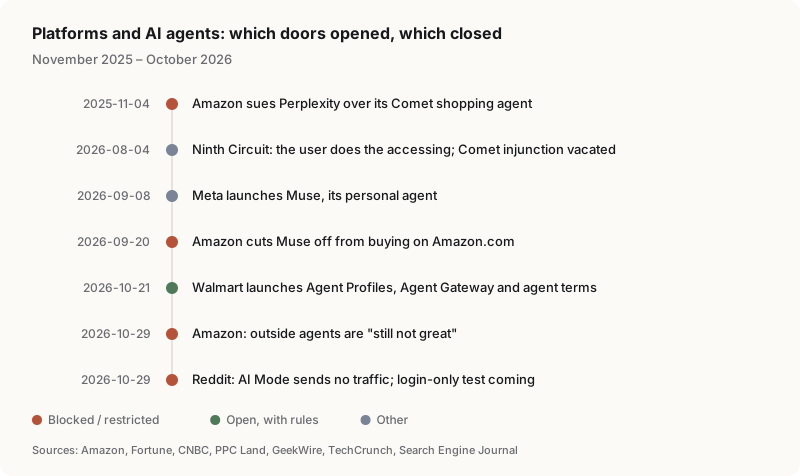
Reddit’s revenue came in at $895 million, up 53% and a little ahead of analyst estimates, yet the stock fell more than 15% after hours. The reason was in its shareholder letter: since the start of October, visits referred from search engines had dropped by more than a million a week on average, and if that pace held, daily active users could fall by a low double-digit percentage in the fourth quarter from the current 130 million. On the call, CEO Steve Huffman pointed at Google’s AI Mode and AI Overviews, and said Reddit would test a logged-in-only experience in some markets outside the US this quarter.
A few hours later Amazon reported revenue of $201.9 billion, up 12%, with AWS up 39%, its fastest growth in nearly five years. One line in the release said that Alexa for Shopping, Amazon’s own agentic shopping assistant, “was used by 400 million+ customers in the last 12 months, with customer interactions up 570% year-over-year.” On the call, CEO Andy Jassy was asked about outside shopping agents such as Meta’s Muse. His verdict: they are “still not great, nor more convenient than coming to a retailer directly.”
A month earlier, Amazon had locked Muse out of its store.
On the same evening, one retail platform and one content platform said the same thing from two directions. AI that runs errands for people, and AI that answers their questions, is being kept out by the big platforms, or at least half out.
The doors of the past year
This did not happen overnight.
In November 2025 Amazon sued Perplexity, arguing that its Comet browser agent was placing orders inside users’ Amazon accounts. According to a case timeline compiled by PPC Land, the trial court granted an injunction in March this year, and on August 4 the Ninth Circuit vacated it, holding that under the federal anti-hacking law it is the user, not the agent’s developer, who accesses Amazon’s computers. On September 10 the court denied Amazon’s petition for rehearing.
That ruling closed one road: Amazon can no longer easily sue agent companies for unauthorized access. But it left another one open. Retailers can still block agents through terms of service, rate limits and technical measures.
Meta launched Muse on September 8. Twelve days later, on September 20, Amazon cut off Muse’s ability to buy on Amazon.com. According to GeekWire, Amazon first asked Meta to leave Amazon out of Muse voluntarily, and only acted when that failed. Users who now try to shop Amazon through Muse see a notice: “Continued access by an unauthorized AI agent violates Amazon’s Conditions of Use, to which our customers have agreed.”
Amazon’s statement at the time said third-party apps that offer to make purchases “should operate openly and respect service provider decisions about whether or not to participate,” and that “agentic third-party applications such as Muse have the same obligations, and we’ve requested that Meta remove Amazon from the experience.” Its specific complaints: Meta never told it Muse would come to its store, the agent doesn’t identify itself while browsing, and it appears to capture and store customer credentials. Meta’s earlier position was that Muse has no visibility into people’s passwords or payment methods, which go into secure storage that Muse can use without seeing.
I wrote about Muse’s growth in Ten million people handed Muse their keys. On Meta’s earnings call, Zuckerberg said Muse had more than 10 million users in the US and Canada, that more than a quarter use it to shop, and that the average purchase tops $200. Fortune quoted him without his naming Amazon: “Obviously, not everyone wants to be an early adopter. That’s fine. We’ll work with folks on the terms that makes sense for them.”
Amazon: its own agent, and everyone else’s
Jassy’s line deserves a second look. He didn’t call outside agents a threat. He called them not great, and not convenient. According to Fortune, he also said they were not the reason advertising came in below expectations this quarter.
Amazon’s ad revenue was $19.6 billion, up 11%. The release blamed the softer growth on “timing anomalies primarily related to Prime Day,” which moved into the second quarter in most large countries this year, and guided to ad growth “in the high teens” for the fourth quarter. On the numbers, there is no sign yet that outside agents are hurting Amazon.
So if the impact is small, why block them?
My reading is that Amazon isn’t protecting today’s orders. It’s protecting who gets to own the step before the order.
When someone shops on Amazon, every step from searching to reading reviews to comparing prices to adding to cart happens on Amazon’s pages. Ads, recommendations, private labels and Prime are all sold inside those steps. If the steps move into Muse’s chat window, Amazon goes from being the mall to being the warehouse. Goods still ship from Amazon, but where customers browse, what they see and whom they choose are no longer up to Amazon.
That’s why Jassy said two things at once: outside agents are “still not great,” and Amazon’s own agent has been used by more than 400 million customers in a year. Amazon also said, per Fortune, that US customers who use its shopping agent spend 50% more per order than those who don’t. That compares users with non-users, so it doesn’t show the agent causes people to spend more. But it does show what Amazon wants: the agent’s seat is valuable, and Amazon intends to sit in it.
According to a roundup by Shopifreaks, Amazon has blocked shopping agents not just from Meta but also from Google, OpenAI and Perplexity over the past few months, arguing that bots that don’t identify themselves put shopper accounts at risk. I’ve only seen that list in one place, so treat it as a pointer.
Reddit: Google still crawls, but no longer sends people
Reddit’s problem is a different one.
For two decades the deal between Reddit and Google was simple. Google crawled Reddit’s threads and linked to them in search results, users clicked through, and Reddit sold ads. Plenty of people add “reddit” to the end of a search precisely to find real people talking.
AI search removes the click. Google puts a summary at the top of the results page, and AI Mode answers in full conversational form, so people read the answer and leave. Huffman’s words on the call, as AdExchanger recorded them: “The reality is, AI Mode does not drive traffic, not for us and not for anybody, as far as I know. And so that’s just a fundamental shift in how Google works. It used to be a traffic driver. Now it’s not.”
He added that “Google is crawling us as hard as ever.” Demand hasn’t changed. The return has.
The numbers show the pressure. According to CNBC, Reddit’s US daily active uniques fell 2% year over year to 50.7 million, the first US decline since its 2024 IPO. According to the shareholder letter as quoted by Search Engine Journal, logged-out US users fell from 30.1 million to 27.3 million in one quarter, while logged-in users edged up from 23.1 million to 23.4 million. Almost all of the loss came from people who arrive from search, don’t sign in, and leave.
Those people were never the main source of revenue. Huffman said logged-in and app users account for more than 80% of Reddit’s monetization. So Reddit’s answer is: if Google isn’t sending people anymore, pull the door in and make visitors sign in. Per CNBC, Huffman said, “Reddit is the last platform to provide basically unfettered logged-out access, and that’s largely because of me, I’ve been holding that line.” He’s letting go of that line now.
The login wall does a second job too. Huffman said, according to SEJ and The Next Web, that “the vast majority” of scraping happens through logged-out access. Reddit licenses its data to OpenAI and Google, and has sued Anthropic, Perplexity and several data-scraping companies. Pulling the door half shut keeps users, and also makes Reddit’s content something you buy rather than take.
How far the door closes is still unclear, and reports differ. CNBC says Reddit will require all users to create accounts. Reuters says sign-ins will be mandated for most content. The Next Web says the front page and shared post links should still work without an account. Reddit hasn’t named countries or a timeline. I lean toward the last reading: a door left open a crack.
Walmart opened a different door
Looking only at Amazon and Reddit, it’s tempting to conclude that every platform is closing up. But eight days earlier, Amazon’s biggest competitor did something else.
On October 21, Walmart CEO John Furner announced in San Francisco that outside AI agents could shop Walmart and Sam’s Club on customers’ behalf, and Walmart published three pieces:
- Agent Profiles. Each agent gets its own identity inside the customer’s Walmart account, with its purchases shown separately. Customers can approve every order or give the agent a spending limit; Walmart’s examples are $50, $100 or $200. Walmart’s analogy: “Think about it like adding someone as a cardholder on your credit card.”
- Walmart Agent Gateway. An MCP-based interface that gives agents product and fulfillment data directly, so they don’t have to scrape pages. It starts as a beta for companies and developers; the beta page PPC Land saw says access is by invitation only.
- Terms for agents. Agents may not act beyond the shopper’s intent, don’t get card details, can’t add or change payment methods, and may only access what the task needs. Agents that break the rules will be blocked.
Walmart also answered an obvious worry: “We price products, not people, so the prices that an AI agent sees are the same prices that a human would see on Walmart.com.”
Walmart isn’t throwing the doors wide open either. Agents need an identity, permissions are drawn by the customer and Walmart together, traffic goes through Walmart’s interface, and according to the beta page PPC Land saw, the gateway connects through Sparky, Walmart’s own shopping assistant. It’s a door with a badge reader.
Why the doors are closing, and how they’ll open
Put these together and my view is this: the big platforms aren’t blocking AI. They’re blocking the anonymous middleman.
Amazon’s stated reason for blocking Muse is that the agent doesn’t identify itself. Reddit is closing logged-out access. Walmart opens up on condition that every agent has a registered profile. Three different directions, one question: who is this, whom is it acting for, and what is it allowed to do?
The old web defaulted to anonymous access. Search engines could crawl freely, people could read without signing in, price-comparison sites could scrape. That default held because of an implicit bargain: you take my content, you send me people. AI agents and AI search break that bargain. They take the content, keep the decision on their side, and stop sending people back.
Once the bargain fails, the platforms’ responses are predictable: close the door, charge for entry, or set rules. Amazon closed the door while scaling up its own agent. Reddit closed the door and charges for data. Walmart set rules, trading a gated door for customer goodwill while keeping a seat for Sparky.
Readers in China will recognize this. In 2008 Taobao blocked Baidu’s crawler, and for years afterward China’s big apps refused to link to each other or let each other crawl, each building its own walls. My sense is that with AI agents, the American web is drifting toward something similar, except this time the walls come with an agent checkpoint: agents with an identity, authorization and willingness to follow the house rules get in, and those that don’t announce themselves stay outside.
For AI companies, that means the idea of an agent that can go to any site and do anything for you won’t arrive soon. Per Fortune, Shopify, Walmart and Best Buy welcome Muse; Amazon doesn’t. What users end up with may not be an all-purpose butler, but a runner who can only work in some of the shops.
For people building agents, content and stores
If you’re building an AI agent product:
- Don’t treat “it can click around web pages” as a moat. The court said the user does the accessing, but platforms can still shut you out with terms and technical measures. Anything that depends on imitating a human clicking through pages can be cut off with a single notice.
- Identify yourself and push for real interfaces. Walmart’s gateway and the Personal Agent Protocol led by Sierra are both paving the way for agents with identities. Getting in early beats playing cat and mouse.
- Tell users plainly where your agent works. People assume an agent can handle anything. Finding out it can’t shop at their favorite store is a bigger letdown than knowing up front.
If you run a content platform or publish on your own:
- Redo the math on search traffic. Reddit has always leaned heavily on Google, and its experience is that AI search still crawls but no longer sends people. If your content depends on search referrals, plan for that traffic to keep shrinking.
- Logged-in users and direct visits are the ones you own. More than 80% of Reddit’s monetization comes from logged-in and app users. For a personal blog or newsletter, that means subscriptions, follows and memberships.
- Decide whether AI gets your content free or pays for it. Big platforms can negotiate licenses and small sites can’t, but you can at least choose what’s public and what sits behind a login.
If you run a store or a service:
- Your next customer may be an agent, but you decide how it comes in. Walmart’s approach is worth studying: give each agent its own identity, let customers set limits, require a human for key steps, and show agents and people the same prices.
- Build your own assistant well. Amazon can afford to block others because its own agent has been used by more than 400 million customers in a year. Without that, closing the door just pushes customers somewhere else.
Final thoughts
On the evening of October 29, Huffman described Google as a former traffic driver, and Jassy said outside agents are “still not great.” Read together, they mark the loosening of an old rule of the web: content and products could be crawled freely, and in return you got traffic and customers.
AI took away the second half of that bargain. Over the next few years, the fight over agents may be less about whose model is smartest and more about who holds badges for the most doors. For ordinary users, that means where your agent can and can’t go will largely be decided not by the agent, but by whoever is standing on the other side of the door.
References
- Amazon, Amazon.com Announces Third Quarter Results (SEC 8-K Exhibit 99.1), 2026-10-29
- Fortune, Amazon CEO says shopping agents like Meta’s Muse ‘not great’, 2026-10-29
- CNBC, Amazon AWS posts 39% revenue growth as cloud rivals also accelerate, 2026-10-29
- Shopifreaks, Amazon CEO Andy Jassy says Alexa for Shopping will be the main agent for shopping Amazon, even as it blocks rival AI agents, 2026-10-30
- PPC Land, Amazon blocks Meta’s Muse AI agent from shopping on its site, 2026-10-08
- CNBC, Reddit shares sink on weak sales guidance and plans login requirement test as Google search traffic shrinks, 2026-10-29
- Search Engine Journal, Reddit CEO Says Google’s AI Mode ‘Does Not Drive Traffic’, 2026-10-29
- Reuters (via Investing.com), Reddit puts logged in experience first as Google AI hits traffic, 2026-10-29
- AdExchanger, Reddit Is Going Login Only. Blame Google, 2026-10-29
- The Next Web, Reddit will make users log in as Google’s AI search cuts its traffic, 2026-10-30
- TechCrunch, While Amazon blocks AI agents, Walmart rolls out the welcome mat, 2026-10-21
- The Next Web, Walmart will let AI agents shop for you, with their own spending limits, 2026-10-23
- PPC Land, Walmart lets AI agents buy within customer-set limits such as $50 or $100, 2026-10-22