
After the Apology: Nvidia's Board Averages Nearly 15 Years of Tenure, Has No Succession Plan and No National Security Expertise

On Sunday, November 8, two documents appeared one after the other in Nvidia’s newsroom.
The first was a letter from Jensen Huang to all employees, titled “A Message to Our Company.” It opens with a sentence that rarely appears in a public company’s press materials: “I was unfaithful to my wife.” Then: “There is no excuse for what I did. I am deeply sorry.” On the national security concerns raised in news reports, he wrote only that the board had started an independent investigation and that he supports it and will cooperate fully. He ended by asking people to give his family privacy.
The second was a statement from the board. A committee of independent directors, assisted by outside independent counsel, will oversee the investigation. The board has “no reason to believe that either national security or NVIDIA secrets were compromised,” and it has confidence in Huang and his leadership team. Nvidia added a line for CNBC the same day: “Today’s news will not slow NVIDIA. Jensen is committed to continuing to lead NVIDIA as CEO without interruption.”
Monday brought a new New York Times story: the Commerce Department’s investigation into Megaspeed, a Singapore data center company suspected of chip smuggling, moved to the Justice Department after Nvidia’s general counsel emailed the investigators. It is now a criminal case. According to Semafor, Nvidia shares were down about 5% that afternoon, erasing more than $200 billion in market value. The Next Web, citing Bloomberg, reported an intraday drop of as much as 8.8%.
I’m not interested in anyone’s marriage. What I care about is that this episode puts three things on the table at once: how a company on the front line of export controls defends itself against intelligence operations aimed at it; why a chip smuggling investigation changed agencies; and whether the board of a company worth trillions of dollars can actually oversee its founder.
What happened over three weeks
The threads go back more than a year. They only came together in the last three weeks.
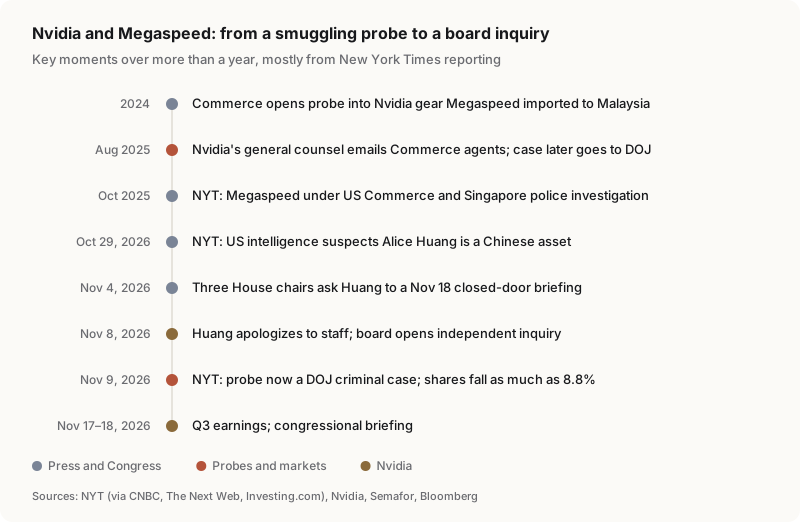
- 2024: the probe begins. According to Finimize’s account of the Times reporting, Commerce’s investigation started in 2024, after Megaspeed imported billions of dollars’ worth of Nvidia AI equipment into Malaysia.
- October 2025: the Times profiles Megaspeed. As summarized by GIGAZINE, the report said the Singapore company was spun out of a Chinese gaming company in 2023, that reporters visiting its Singapore office on a weekday found only two employees, and that it was under investigation by both the US Commerce Department and Singapore police on suspicion of diverting chips to China.
- October 29, 2026: the intelligence angle surfaces. Citing people briefed on the matter, the Times reported that US intelligence agencies had surveilled a woman close to Huang. She is Alice Huang, a former Megaspeed executive (no relation to Jensen Huang), and officials worried she was helping Beijing extract information from Nvidia and its CEO. Nvidia said at the time that Huang’s interactions with her were “not unusual or unexpected,” that customers get no information relevant to national security, and that the diversion allegations against this regional cloud “were thoroughly investigated and debunked last year.”
- November 4: Congress writes. The Republican chairs of the House Foreign Affairs Committee, the Select Committee on China and the Intelligence Committee asked Huang to attend a closed-door briefing on November 18, the day after Nvidia reports third-quarter results. “Recent reports raise significant national security concerns,” the letter said.
- November 6 to 8: more detail. According to CNBC’s account, the Times reported that Trump administration policymakers received a memo this spring identifying Alice Huang as recruited by China’s Ministry of State Security and describing her relationship with Huang. A later Times report said the memo was prepared under the oversight of Secretary of State Marco Rubio. On Sunday came the apology and the board inquiry.
- November 9: the agency switch is reported. The same day, Chinese foreign ministry spokesperson Guo Jiakun told reporters that the so-called Chinese spy allegation was unsubstantiated and a smear against China.
To be clear: as of today no report accuses Jensen Huang of breaking any law, and no report says Alice Huang or Megaspeed has been charged. Nearly everything about the intelligence claims comes from anonymous officials and people familiar with the matter, and most of it traces back to a single outlet, the Times.
Separate the private from the public
The part spreading fastest on social media is the private one. I think it is the least important. Three distinct threads matter.
The first thread is personal conduct. The only thing Huang admits in his letter is infidelity. He does not admit sharing information with anyone, and the board says it has no reason to think secrets were compromised. That part belongs to him and his family.
The second thread is disclosure. Former SEC chair Gary Gensler told Semafor that, given Huang’s earlier insistence that his dealings were completely normal, “it appears [Huang] did mislead the public.” Whether that was material is the question, he said, “and today’s stock drop will suggest to a court it was material.” Asked whether the SEC would investigate, a spokesperson declined to comment. Gensler himself noted that this administration does things differently and that “the President has already spoken on the matter.”
What the President said, on Sunday evening: “I haven’t heard he’s done anything wrong.” Trump said Huang should stay on as CEO and that he would bring him along on his upcoming trip to China.
The third thread is the one that matters: where the security perimeter sits at a company at the center of export controls. Nvidia is not an ordinary chipmaker. Almost every step of US chip policy toward China is carried out through its sales organization: who can buy, who makes the approved list, who a cloud partner’s customers are allowed to be. On November 3 I wrote about Nvidia verbally telling cloud partners that at least 51% of their business must go to non-Chinese customers. The people enforcing that rule are Nvidia’s own sales and regional teams.
At a company like that, a close relationship between the CEO and an executive at a customer suspected of diverting chips is a security problem in itself, even if nothing leaked. In October Nvidia said: “We’re confident that if the U.S. government believes that any person is a threat to American industry, it would let us know.” Yet according to the Times, a memo reached senior policymakers this spring. Read today, that line sounds less like reassurance and more like an admission that the company’s defenses depend on outside warnings rather than its own controls.
The case that went to the Justice Department
For readers in China, I think Monday’s story matters more than the apology. Pieced together from The Next Web, Investing.com and Finimize, all relaying the Times report, the sequence looks like this:
- In August 2025, Nvidia general counsel Tim Teter emailed investigators at Commerce’s Bureau of Industry and Security, saying Jeff Kessler, the senior Commerce official in charge of export controls, had given Nvidia permission to contact them. Kessler reports directly to Commerce Secretary Howard Lutnick.
- The investigators declined to meet and forwarded the emails to Kessler. According to a Commerce official, Kessler told them to handle the case strictly by the book. The same official said Kessler did not direct investigators to share information with Nvidia or interfere in their decisions.
- The episode raised concerns inside Commerce that the department’s contacts with Nvidia could compromise the investigation. The Justice Department then asked Commerce to pause its work and hand over the case. The reports give no date for the transfer. The Justice Department declined to comment.
- Nvidia’s explanation is that it contacted investigators “to answer their questions, provide information we have gathered from the field, request their guidance and instructions and ask whether they have any follow-ups.”
- Megaspeed denies smuggling, saying inspections by the Bureau of Industry and Security, Malaysia’s Ministry of Investment, Trade and Industry and Nvidia itself found no violations, and that it is running its own internal review.
One more detail worth noting: according to Investing.com, other agencies have proposed adding Megaspeed to the Entity List, but Commerce has not done so. Commerce has not added any company to the list in more than a year, the longest such gap in 18 years.
Put together, my reading is this: in export controls, Nvidia plays three roles at once. It is the regulated seller, the compliance arm that vets buyers on the government’s behalf, and, in this case, a party trying to engage with an investigation into its own customer. Those roles were always in tension, and the system ran on mutual trust. Moving the case from Commerce to Justice, and from an administrative inquiry to a criminal one, suggests that at least some officials no longer want to rely on that trust.
The board: nearly 15 years of average tenure
The first two threads await investigation results. The third question can be answered now: Nvidia’s board.
Semafor laid out several numbers on Monday:
- Nvidia’s directors have served an average of almost 15 years, nearly twice the S&P 500 average. Huang and two other directors have been on the board since the company’s founding 33 years ago.
- The lead independent director is a 77-year-old former law firm executive. No director is a current or former S&P 500 CEO, and none has national security experience. Meta and Microsoft each have four big-company CEOs on their boards.
- Nvidia has never publicly signaled a succession plan. It has no president and no chief operating officer, and Huang has more than 50 direct reports. Both of his adult children work at the company.
- The word “succession” appears zero times in Nvidia’s latest annual report. It appears 25 times in Microsoft’s and 16 times in Alphabet’s.
Jill Fisch of Penn Carey Law told Semafor that the board’s composition suggests “a CEO exercising effective control over the board instead of vice versa.” Columbia’s John Coffee offered a counterweight: “negligence doesn’t require that you shoot yourself in the foot by firing a well regarded CEO.”
I agree with Coffee, and I don’t think a board should replace a CEO over a letter of apology. But the board’s Sunday line, that it has “no reason to believe” secrets were compromised, carries little weight when the investigation has only just begun. A board with no national security experience evaluating an intelligence operation aimed at its own CEO needs outside help, and the statement doesn’t even name the outside counsel.
Founders running companies for decades with boards that follow their lead is common in Silicon Valley, and it is often part of why those companies succeed. The difference is that Nvidia’s position today is not what it was ten years ago. It is no longer just a company. It is a point through which US technology policy toward China is carried out, and that position demands a level of governance a gaming graphics card company never needed.
What it means for readers in China
This looks like an American corporate scandal, but it will have real effects on several groups of people here.
- Teams renting compute in Southeast Asia should expect compliance to keep tightening. With Megaspeed now a criminal case, Nvidia will scrutinize its Southeast Asian cloud partners harder, if only to show it is clean. Site visits, end-user checks and caps on Chinese customers may move from verbal guidance to written contract terms. If you train or serve models in offshore data centers, map your contracting entities, data flows and fallback options now, and don’t bet the business on a small cloud provider whose origins are hard to explain.
- Don’t treat “Nvidia says it’s fine” as a compliance guarantee. Megaspeed says Nvidia inspected it and found nothing, and Nvidia said the diversion claims were debunked. That did not stop the Justice Department from opening a case. A supplier’s endorsement and a regulator’s conclusion are different things.
- Founders can use this to check their own governance. In startups it is normal for a founder to decide everything. But once a company touches export controls, data security or government customers, it is worth deciding before anything goes wrong whether the board has people who understand those areas, and who takes over if a key person is suddenly out. Don’t wait for the stock to fall.
- Dates to watch: November 11 is Huang’s deadline to answer the congressional request. On November 17 Nvidia reports third-quarter results; will management address this unprompted? Will Huang attend the November 18 closed-door briefing? Will the board name its outside counsel and the scope of the inquiry? Will Megaspeed be added to the Entity List?
Final thoughts
Huang’s letter reads as sincere, but it answers a family question. What the market was really asking on Monday were two other questions: can Nvidia protect itself from infiltration, and is the line between the company and its regulators clear? Neither the letter nor the board statement answers them.
I understand that for a company its founder built by hand, the hardest thing isn’t admitting a mistake. It’s admitting the company has grown too big to rest on one person’s judgment. We don’t know what the board’s investigation will conclude. But it should answer one more question along the way: if Jensen Huang were gone tomorrow, who would run this company?
References
- NVIDIA, A Message to Our Company, 2026-11-08
- NVIDIA, Statement From NVIDIA Board of Directors, 2026-11-08
- CNBC, Nvidia CEO faces Congress scrutiny over Chinese spy reports, 2026-11-08
- CNBC, Nvidia responds to report Jensen Huang was target of Chinese asset, says diversion allegations were ‘investigated and debunked’, 2026-10-29
- Semafor, With a weak board and no successor, Nvidia confronts a governance crisis, 2026-11-09
- The Next Web, Commerce halted its Megaspeed probe after Nvidia stepped in, NYT reports, 2026-11-09
- Investing.com (via Yahoo Finance), Nvidia intervention preceded transfer of chip probe to Justice Department, 2026-11-09
- Finimize, Nvidia’s Megaspeed Case Lands With The Justice Department, 2026-11-09
- The New York Times (Ana Swanson, Devlin Barrett), report on the Megaspeed probe’s transfer to the Justice Department (not read directly; as relayed by the three outlets above), 2026-11-09
- GIGAZINE, report on Megaspeed and the flow of Nvidia chips (summarizing the New York Times report of 2025-10-09), 2025-10-12