
A rule nobody wrote down: Nvidia wants its clouds to sell at least 51% to non-Chinese customers
On November 3 the Financial Times, citing five people familiar with the matter, reported that Nvidia has told its cloud computing customers that from now on at least 51% of their services must be sold to companies that are not Chinese.
Three details are worth noting up front. First, the requirement was passed on verbally by Nvidia’s sales and regional teams; there is no written document. Second, according to two of the sources, it applies to Nvidia’s customers worldwide, not only to data centres in Asia. Third, it covers only new contracts; existing leases are untouched. The report adds that Nvidia had never before placed conditions on who its cloud customers’ customers could be.
Nvidia neither confirmed nor denied the figure to AFP. Instead it issued a statement: data centres and clouds built on American chips are the foundation American model and application makers need to compete worldwide; long-standing US policy encourages every cloud to build on American infrastructure and win business everywhere it can; and “if the world’s clouds rely on foreign-made chips, the model and application layers will be foreign-built as well.”
That afternoon China’s foreign ministry spokeswoman Mao Ning was asked about it at the regular briefing. “I’m not aware of the specifics,” she said. “We have always believed that all parties should cooperate on the principles of fairness, transparency and non-discrimination.”
So as of tonight this is a reported rule: no document, and a company that will neither own nor disown it. I still think it deserves a close look, because it shows that the effort to limit Chinese access to advanced compute has moved from controlling who buys the chips to controlling who rents the computing power.
Which route it closes
To understand the rule, start with the steps that came before it.
The US began restricting exports of advanced AI chips to China in 2022. But export controls govern physical chips. A chip cannot be shipped into China, yet a chip sitting in a data centre in Singapore, Malaysia or Thailand can rent its computing power to a Chinese company over the internet, and for a long time that was outside the rules. In August, Cassia King of the Institute for AI Policy and Strategy put it bluntly to CNBC: the export control regime “controls physical AI chips. It does not cover remote access to those chips.”
Plenty of people used that route. The Wall Street Journal reported one case in which four engineers from a Chinese company flew from Beijing to Malaysia, each carrying a suitcase holding 15 hard drives, to train a model on roughly 300 rented servers with advanced Nvidia chips. In August CNBC reported that White House official Michael Kratsios had accused Moonshot AI of using GB300 chips through a facility in Thailand, and that ByteDance, Alibaba and Tencent had reportedly used Nvidia compute remotely in Thailand, Malaysia and Japan. Most of those companies did not respond, and most of the claims rest on anonymous sources.
Over the past year Washington tightened several lines at once:
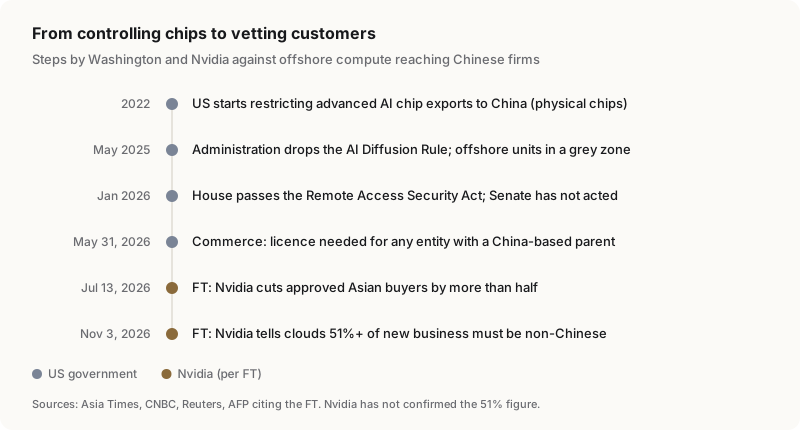
- Legislation is slow. The Remote Access Security Act, which would bring cloud access under export controls, passed the House in January. When CNBC reported in August, the Senate still had not passed it.
- Commerce targets who the buyer is. On May 31 the Bureau of Industry and Security issued guidance that any entity whose ultimate parent is headquartered in China or Macau needs a licence for advanced chips, wherever it is located. Chips already installed and running do not have to be switched off.
- Nvidia targets who it sells to. On July 13 the FT reported that Nvidia had introduced a “white list” of companies that passed tougher compliance checks and more than halved the number of Asian customers allowed to buy its AI chips, with Singapore, Malaysia and Japan in focus; most of those dropped were neoclouds. Staff now visit data centres, verify contracts and interview end users, with the Commerce Department involved.
The May guidance closed the door on Chinese subsidiaries abroad buying chips directly. The July white list closed it on suspect intermediaries. What remained was a compliant overseas cloud renting compute to Chinese companies. That is exactly where the 51% rule lands.
Prices show how valuable that route is. According to the FT’s sources, a B300 rack sells for about $600,000 internationally but changed hands in China last month for 18.5 million yuan, about $2.8 million, close to 4.7 times as much. With a gap that wide, the incentive to find a way around never goes away.
Why 51%, and why not on paper
This section is my reading, not reported fact.
51% is not a ban; it is a majority. Nvidia is not telling its cloud customers to stop serving Chinese firms. It is telling them Chinese customers cannot be the bulk of the business. The logic resembles a control test: as long as non-Chinese customers are the majority, the cloud is still an extension of the American stack abroad rather than a data centre held on behalf of Chinese companies. Nvidia’s statement follows the same line. Its emphasis is that the world’s clouds should run on American chips, not whether Chinese customers should be allowed.
Saying it verbally leaves room. A written policy would have to answer awkward questions. Is 51% measured by revenue, by compute or by customer count? What counts as a Chinese company: one registered in Singapore with a parent in Beijing? What about capacity re-rented further downstream? None of the reports answers these. A verbal requirement does not need to, and can be negotiated customer by customer. The price is transparency: cloud providers cannot know exactly where the line is, so they will stay well inside it.
Nvidia has the leverage to enforce it. It is not a regulator, but it controls the scarcest thing in the market: chip allocation. The July white list showed that customers who fail its checks lose the right to buy. A cloud provider that depends on Nvidia’s next generation to expand is unlikely to pick a fight over Chinese customers.
It also suits Nvidia. Over the past year the company has repeatedly been linked to chips leaking into China, and the smuggling cases keep coming. On October 1 the US Justice Department charged a California server reseller with routing more than $300 million of export-controlled servers to China through Malaysia and Singapore; the indictment says his company received over $176 million from two Malaysian shipping firms between January and October 2024. Earlier this year several senior Super Micro employees were charged over roughly $2.5 billion of Nvidia AI servers smuggled into China. In that climate, tightening its own customer base is cheaper than waiting for the regulators.
What happens to Southeast Asia’s data centres
The most direct pressure falls on data centres and cloud providers in Southeast Asia.
The FT quoted a Singapore-based cloud provider saying it is hard to find enough non-Chinese customers outside the US, and that strict enforcement would clearly hurt its business. Several reports note that Chinese tech companies have been major buyers of capacity in the region, but none gives a share, and I could not find a reliable figure.
Then there is supply. CNBC, citing DC Byte, reported 31 planned data centres of 100MW or more across Malaysia, Indonesia and Thailand, against two operating today. Much of that capacity was planned for regional AI demand, and a good part of that demand comes from Chinese companies. If Chinese customers can be no more than half of new contracts, these new halls either find enough non-Chinese tenants or slow down, or turn to designs that do not need Nvidia’s newest chips.
The responses I can think of each have a cost:
- Find non-Chinese tenants. The obvious move, but outside the US there are not many companies with large AI training needs. Everyone will chase the same customers and prices will fall.
- Restructure the deal. For example, have a Chinese customer sign through a local entity. In the Journal’s case, the Malaysian data centre did ask its Chinese client to work through a Malaysian company. But the May guidance looks at the ultimate parent and the July checks interview end users, so this is getting riskier.
- Live on existing contracts. Signed leases are unaffected, so current business will not stop overnight. The real impact is on renewals and new capacity. Whether a renewal counts as a new contract, the reports do not say.
What it means for teams in China
For Chinese model companies the message is plain: renting Nvidia’s latest compute through overseas clouds will get harder and more expensive.
Existing contracts buy some time. Meanwhile new capacity will shift further toward domestic chips. Bloomberg reported on September 4 that DeepSeek plans to deploy at least 160,000 Huawei Ascend 950DT chips at a roughly 1GW site in Ulanqab, Inner Mongolia; according to Bloomberg those chips are mainly for inference, with training still on Nvidia. Other reports say DeepSeek aims to start pre-training on Ascend as early as the end of this year. The two accounts do not match, so I go with the more conservative one. Meituan’s LongCat-2.5, which I wrote about yesterday, also stressed training on domestic chips (see Meituan’s 1.6-trillion-parameter model).
My view: the 51% rule will not cut Chinese companies off from compute overnight, but it changes how the sums are done. Until now, renting Nvidia abroad and buying domestic chips at home were two options you could switch between. From here the first one becomes uncertain on price, availability and compliance risk, and teams should treat domestic chips as the main road rather than the spare tyre.
For teams renting compute abroad
If your company uses Nvidia compute through an overseas cloud provider, here is what I would do first:
- List your contract end dates. Reports say existing leases are untouched, but a renewal may be treated as a new contract. Know which capacity you will still have next year and which may not be renewed.
- Ask your provider directly. The rule is verbal and enforcement will vary between providers. Rather than wait for a sudden price rise or a refusal to renew, ask now how they plan to balance their customer mix and whether they will need more information about who you are.
- Don’t bet on signing through a different entity. The May guidance looks at the ultimate parent, the white-list checks interview end users, and the indictments keep coming. For a company that plans to be around for a while, trading compliance risk for short-term compute is a bad deal.
- Start porting to domestic chips earlier. Move inference first and trial training step by step. Engineering teams need time to deal with differences in operators, interconnect and frameworks. The later you start, the less choice you have.
- Save compute in the model and product. When compute gets expensive, distillation, quantisation, mixture-of-experts and caching stop being nice-to-haves and become a competitive edge.
For Southeast Asian cloud providers and Chinese cloud companies expanding abroad, the question runs the other way: build a customer base that does not depend on Chinese clients, quickly, or new capacity will struggle to get chips under Nvidia’s new terms.
Closing thoughts
What strikes me most here is not the number 51%, but how it is enforced. The rule is not written down, the enforcer is a chip company, and the enforcement tool is its chip allocation. That may work faster than a law, and it is harder to appeal.
For teams in China, I think the practical step is to stop treating rented overseas Nvidia compute as something you can rely on long term. The existing contracts are still there and still usable. Capacity planning, though, should start now on the assumption that this route keeps getting narrower.
References
- AFP (via Tech Xplore), Nvidia orders data center clients to reduce China exposure: FT, 2026-11-03
- AFP (via Malay Mail), Nvidia tells data centre partners to curb business with Chinese clients, FT reports, 2026-11-03
- Techzine, Nvidia imposes strict requirements on cloud providers, 2026-11-03
- The Next Web, Nvidia tells cloud partners to cap Chinese business at 49%, FT reports, 2026-11-03
- Seoul Economic Daily, Nvidia Tells Cloud Clients 51% of Capacity Must Go to Non-Chinese Buyers, 2026-11-03
- Liberty Times, 輝達首祭「51%非中國客戶」新規, 2026-11-03
- The Paper, 外交部回应“英伟达要求数据中心合作伙伴必须将至少51%的服务提供给非中国企业”, 2026-11-03
- Reuters (via Yahoo Finance), Nvidia halves Asia buyer list in China chip crackdown, FT reports, 2026-07-13
- Asia Times, Nvidia GPU crackdown hits China-linked Southeast Asia data centers, 2026-06-04
- CNBC, The U.S. banned Nvidia’s best chips from going to China. Now it’s trying to close a crucial loophole, 2026-08-19
- The Edge Malaysia, Chinese firm training AI models in Malaysia at Nvidia-powered data centres, WSJ reports (citing The Wall Street Journal)
- US Department of Justice, California Man Arrested for Smuggling More Than $300 Million in Export-Controlled Computer Servers to China, 2026-10-01
- Bloomberg (as reported by multiple outlets), DeepSeek’s plan to deploy 160,000 Huawei Ascend 950DT chips, 2026-09-04