
Meituan's 1.6-trillion-parameter model: 10 wins and 17 losses against Opus 5, on Chinese chips

On the morning of November 2, Meituan’s tech team released LongCat-2.5. The first paragraph of the official blog post is short: a native multimodal model for long-horizon agentic tasks, 1.6 trillion parameters in total, about 48 billion activated per token, built on LongCat-2.0 with stronger native visual understanding and agentic coding.
You can try it online or call it through an API. The GitHub and Hugging Face buttons at the top of the post both say “Coming soon”: the weights are not out yet.
Chinese media picked the story up quickly, and most headlines landed on two phrases: “1.6 trillion” and “domestic compute”. NetEase’s AI desk went further, writing that it was “the largest training job completed on domestic compute so far.”
I spent the evening with Meituan’s post and went through all 31 rows of its evaluation table. This piece tries to answer three questions: how to read the scorecard, what Meituan actually says about training on Chinese chips, and why a food-delivery company wants its own model at this scale.
The scorecard: 10 wins, 17 losses against Opus 5
At the end of the post is a large table comparing nine models: LongCat-2.5, LongCat-2.0, GPT-5.5, GPT-5.6-Sol, Claude-Opus-4.8, Claude-Opus-5, GLM-5.3, kimi-k3 and DeepSeek-V4.1-Flash, across 31 benchmarks grouped into coding agents, general agents and vision.
NetEase summed it up as scoring “between Claude-Opus-4.8 and Claude-Opus-5, and above Claude-Opus-5 on some benchmarks.” Counting row by row, that summary mostly holds:
- Against Claude Opus 5: 10 wins, 17 losses. Of the 27 benchmarks where both have a score, LongCat-2.5 wins 10. Most of the losses are on the hardest coding tests: 38.5 vs 53.9 on Terminal Bench v4.0, 25.5 vs 37.0 on Program Bench, 60.5 vs 75.3 on NL2Repo, 47.8 vs 62.2 on SWE Atlas test writing.
- Against Claude Opus 4.8: 18 wins, 6 losses. It wins almost every coding row, losing on NL2Repo, test writing, Claw-Eval and three vision tasks.
- Against GPT-5.6-Sol: 20 wins, 7 losses.
- Against DeepSeek-V4.1-Flash: 12 wins, 14 losses. This is the comparison I would look at hardest. A model with “Flash” in its name beats LongCat-2.5 on DeepSWE (74.2 vs 64.6), Terminal Bench v2.1 (90.6 vs 88.4), AutomationBench, SkillsBench and MCP Atlas.
So “somewhere between Opus 4.8 and Opus 5” is broadly fair. Among Chinese models, though, it is not running away from the field.
There is one more detail worth reading. A footnote under the table says that scores for other models marked with an asterisk come from public technical reports, blog posts or official leaderboards; scores without one were run by Meituan and are “indicative only.”
Apply that to the 10 wins over Opus 5, and six of them are against Opus 5 scores Meituan ran itself: PaperBench, SWE Atlas refactoring, ResearchRubrics, SpreadsheetBench 2, 3DCodeBench, and LongCatClawBench, which Meituan built. The other four are wins against Opus 5’s published numbers: BrowseComp (91.9 vs 90.8), AutomationBench (51.8 vs 50.3), SkillsBench (63.3 vs 60.4) and CharXiv-RQ (90.2 vs 89.3). Each margin is under three points.
I am not suggesting Meituan’s own runs are wrong. Running competitors yourself and labelling it clearly is the honest way to do it. But readers should know that most of “beats Opus 5 on some benchmarks” was measured in Meituan’s own setup, and that published scores and in-house runs may use different harnesses, so they are not strictly comparable.
Another telling detail is the harness. According to the notes, Meituan ran Terminal Bench, Program Bench and NL2Repo inside Claude Code, with a 512K context. A Chinese model being scored inside Anthropic’s tool says something on its own: a model has to work well in whatever tools developers actually use.
From 2.0 to 2.5: same size, different training
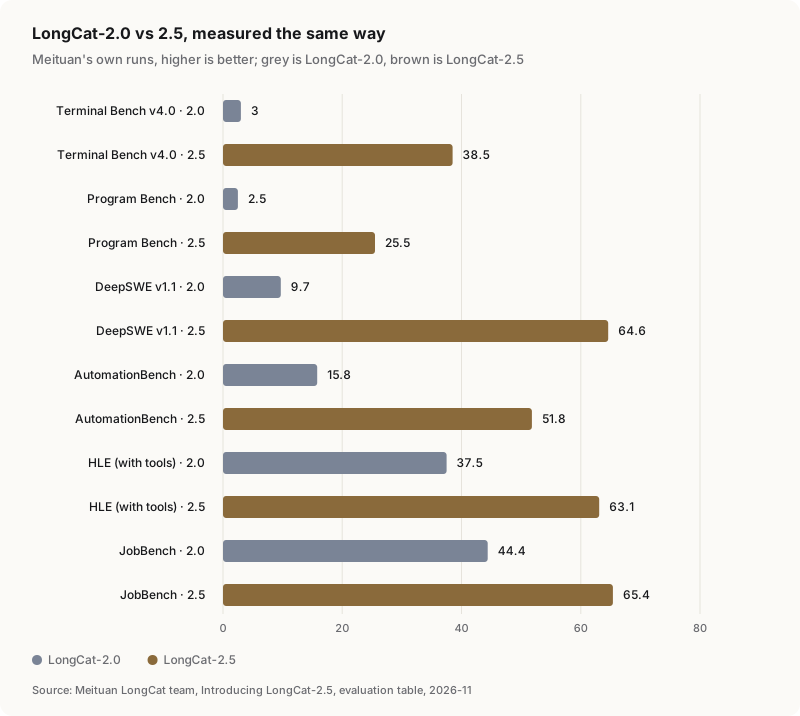
The gap that stands out more than the one with competitors is the gap with its own predecessor. The table includes a LongCat-2.0 column, also run by Meituan, on the same setup:
- Terminal Bench v4.0: 3.0 to 38.5.
- Program Bench: 2.5 to 25.5.
- DeepSWE v1.1: 9.7 to 64.6.
- AutomationBench: 15.8 to 51.8.
Several rows jump from single digits to dozens. And according to Meituan’s GitHub page, LongCat-2.0 was already a 1.6-trillion-parameter model with about 48 billion active, pretrained on more than 35 trillion tokens over “millions of accelerator-days.” The two generations are the same size.
My reading is that the improvement comes mainly from post-training, not from scaling up. That is also where the post spends most of its words, and a few passages are specific:
Where the tasks come from. Meituan filters GitHub pull requests and linked issues, has agents annotate the tasks and build environments, then validates them with fail-to-pass and pass-to-pass tests. It also adds real internal coding tasks and their acceptance criteria.
Failures become training data. In the post’s words: “We also convert real-world agent failure trajectories into reproducible, verifiable training tasks, continually adding targeted training data to address model capability gaps.” Wherever the model gets stuck in real use becomes a problem for the next round.
Guarding against cheating. I found this part the most concrete. Training environments have network access disabled and git history and cached files removed, and an LLM judge audits trajectories for exploits. The reason is simple: if the model can look up the answer online or dig the original fix out of git history, what it learns is to cheat, not to code. There are also penalties for repetitive reasoning and repeated tool calls, and rewards are redistributed to counter overthinking and runaway response length.
Training across harnesses. During RL, tasks aligned with different benchmarks and different agent scaffolds are mixed in varying proportions, and the post says gains across tasks reinforce one another.
None of this is new in itself; labs abroad and in China are all working along these lines. What stands out is how openly Meituan describes it, down to the anti-cheating measures. For teams training their own agents, this section is more useful than the scorecard.
Chinese chips: what Meituan says, and what it doesn’t
“Chinese chips, Chinese models” was the most common label in this week’s coverage. Checking it against the official post, here is what can and cannot be confirmed.
Confirmed in the post:
- Long-context training and W4A4 inference were optimized on domestic accelerators. The wording is “we optimize long-context training and W4A4 inference on domestic AI accelerators.”
- Each accelerator has less than 80 GB of memory. Because of that, the post says, the training system prioritizes memory efficiency and aligns its parallelism with a “supernode” architecture, keeping communication inside the supernode’s high-bandwidth interconnect.
- Some concrete numbers. In long-sequence fine-tuning, the new FSDP setup delivers 86% higher per-device throughput than a DDP baseline. W4A4 inference quantizes both expert weights and activations to 4 bits and runs them on native INT4 units. Against a W8A8 baseline, online stress tests show prefill throughput up 43.3%, decode throughput up 42.77%, time to first token down 15.91% and time per output token down 19.72%. The post says the quantized model performs comparably to the unquantized one on all evaluated downstream tasks.
One generation back:
The “fully domestic” claim was actually made about the previous model. In its second-quarter results on August 28, Meituan described LongCat-2.0, launched in June, as, per Sina Tech’s account, “the industry’s first trillion-parameter model to complete the full training and inference process on a fully domestic compute cluster.” Xinhua Finance’s account was more specific: a “50,000-card domestic compute cluster.” LongCat-2.5 builds on 2.0, so Meituan’s own statements support the view that the base model was pretrained on Chinese chips.
Not in the post:
- No chip vendor is named. The post only says “domestic AI accelerators.” LongCat-2.0’s GitHub page says training and deployment were built on “AI ASIC superpods,” again without naming a supplier.
- No scale for this round of post-training. How many accelerators and for how long is not stated.
- “Largest training job” is the media’s phrase. I could not find NetEase’s line about “the largest training job completed on domestic compute” in Meituan’s post. “Industry first” is Meituan’s own description, and I found no independent check of it.
My view is that what is confirmed is already significant. With under 80 GB per accelerator, training a 1.6-trillion-parameter model means memory efficiency dictates almost every engineering choice; and 4-bit inference that raises throughput by about 40% feeds directly into what this model will cost to serve. Whether Chinese chips can train a model close to the frontier has been an open question for a year or two. LongCat-2.5 moves the answer closer to yes.
It is still worth not overstating it. The chip model is undisclosed, and a 50,000-card cluster is not something many companies can command. From the outside it is impossible to judge what that “yes” cost, or whether others could follow.
Why would a food-delivery company train its own?
This was the question I most wanted answered after reading the release.
Start with what Meituan says. According to NetEase, Meituan has built an AI business workbench called Miaoshou on the LongCat models. It helps merchants understand industry metrics and brand rules, and, within what the merchant authorizes, calls tools and systems to carry out business tasks.
Miaoshou is not new. According to an October 20 column on Woshipm, it was originally called CatPaw and took its Chinese name in September, shifting from a general office tool to a business workbench for restaurants, hotels and instant retail. At Meituan’s food-delivery industry conference on October 22, the company launched a delivery edition. Securities Market Weekly reported that Xue Bing, head of Meituan’s food-delivery business, said Meituan would give every restaurant merchant in China a free “AI store manager”; the report said tens of thousands of small merchants already use it in daily operations, and that Meituan works with more than 200 restaurant chains including Guming, Yiheyuan and Lanxiangzi. An earlier tool, Smart Shopkeeper, covered about 1.3 million restaurant merchants nationwide, according to a Jiemian report in September.
Then the money. Meituan’s revenue in the second quarter was 104.6 billion yuan, up 14.4% year on year; R&D spending was 7.7 billion yuan, up 22.5% and equal to 7.3% of revenue. According to Xinhua Finance and Sina Tech, Wang Xing said in the results release: “We will firmly step up investment in our ecosystem and technology, and push AI into real business scenarios, to improve the experience of users and merchants and the company’s operating efficiency.” Time Finance reported that management said on the earnings call that Meituan would not become a “token factory,” meaning it does not plan to make money by selling model usage. The same report quoted Wang as saying fully domestic training and inference “help us build a stronger advantage in long-term cost and infrastructure control.”
I read Meituan’s logic as three layers:
- Its AI is meant to do work, not chat. Meituan’s core business is transactions, merchant operations and delivery. Reading a shop’s data, editing a menu, planning a promotion: these are long tasks that call tools and change systems. The long-horizon agent and coding skills LongCat-2.5 focuses on map onto them, and benchmarks in its table like JobBench, SpreadsheetBench and FinSearchComp lean toward office and business work.
- Renting someone else’s model leaves cost and data out of your hands. With over a million merchants and a large daily volume of business tasks, paying per token to an outside model would add up quickly; and a platform has to answer for who processes merchants’ business data.
- Chinese chips are an insurance policy. Meituan does not control the supply of high-end GPUs. Running both training and inference on domestic hardware removes one point where it could be cut off.
I do have one question, though. On the hardest coding tasks, LongCat-2.5 still trails Opus 5 by a clear margin and trades wins with DeepSeek-V4.1-Flash. If Meituan’s main use is merchant operations, the numbers it most needs to publish are from those settings: after merchants adopt Miaoshou, which tasks does AI actually finish, and how often does it get them wrong? Those numbers do not exist publicly yet.
For people choosing a model
If you are considering LongCat-2.5, or choosing among Chinese models, a few suggestions:
- Check the asterisks first. For any vendor’s table, separate the competitor scores that are public from those the vendor ran itself. LongCat’s table labels this clearly; others may not.
- Test on your own tasks, in your own harness. Meituan ran its coding evaluations in Claude Code. If your team uses a different agent framework, results may differ a lot. Pick 20 to 50 of your real tasks and run them three times each. That beats any leaderboard.
- Wait for the weights and the license. LongCat-2.0’s weights were released under the MIT license, but 2.5’s weights are not out and its license has not been announced. If you plan to self-host, wait for both.
- Count total tokens, not just price per token. Long-horizon agent tasks can run to hundreds of thousands of tokens. When Kimi K3.1 Pro cut its per-token price recently, users’ bills went up anyway, because the same tasks consumed more tokens. Compare models on what it costs to finish the same batch of tasks.
- Ask which chips it is deployed on. If your organization has domestic-hardware requirements, the W4A4 numbers on Chinese accelerators are worth a close look, but confirm with Meituan exactly which chips are supported; the post does not say.
Final thoughts
What strikes me most about LongCat-2.5 is not the 1.6 trillion figure but two plainer things.
One is that a model of the same size, trained differently, went from single digits to dozens on some of the hardest coding benchmarks. More and more, the gaps between large models come down to the engineering details of post-training: where the tasks come from, how you stop the model cheating, how failures become the next round’s problems.
The other is that Meituan labelled which scores in its table were public and which it ran itself. People reading scorecards should pay more attention to details like that, and companies writing them should show more of that kind of honesty.
A food-delivery company has trained a model close to the frontier on Chinese chips. That is worth noting. But whether it is any good will be decided by the noodle-shop owner still doing the accounts after closing time, and whether he gets to bed a little earlier because of it.
References
- Meituan LongCat team, Introducing LongCat-2.5 (evaluation table and technical notes), 2026-11-01 (date shown on page)
- Meituan LongCat team, LongCat-2.0 (GitHub README), 2026-07
- NetEase AI (via Sina), 美团发布LongCat-2.5大模型, 2026-11-02
- Kanchai (via Sina Tech), 美团龙猫发布LongCat-2.5原生多模态AI模型:1.6T参数,面向长程智能体任务, 2026-11-02
- TechNode, 美团发布LongCat-2.5,强化看图编程和复杂项目开发能力, 2026-11-02
- National Business Daily (via Sina), 美团技术团队发布LongCat-2.5, 2026-11-02
- Sina Tech, 王兴最新发声! (Meituan Q2 2026 results), 2026-08-28
- Xinhua Finance, 美团2026年二季报:营收增长14.4%至1046亿元,推动AI融入真实业务场景, 2026-08-29
- Time Finance, 美团二季度营收超千亿,王兴谈AI:不做“Token工厂”,融入真实业务场景, 2026-08-31
- Jiemian (via Eastmoney), 美团:AI工具“智能掌柜”已覆盖全国约130万餐饮商家, 2026-09-20
- Juchao WAVE (Woshipm), column on Meituan’s AI business, 2026-10-20
- Securities Market Weekly, 美团发布商家AI助手“妙手外卖版”,将向全国外卖商家免费提供“AI店长”, 2026-10-23
- NetEase Tech, K3.1 Pro发布才两天,Kimi道歉补额度!, 2026-10-27