
"May imminently": Anthropic's prospectus admits it can't clearly see how fast AI is building AI

On November 2, US time, Anthropic filed an amended S-1 prospectus with the Securities and Exchange Commission. Yesterday’s piece, Revenue up 47%, and Anthropic is back in the red, covered the financial figures the amendment filled in. Today’s piece is about a different edit in the same document, in the risk factors section. It is only a few sentences long.
The original prospectus of October 26 contained this line: “we may not identify a significant acceleration in our rate of development until after it has occurred.”
A week later, the amendment reads: “we have in the past not identified, and may in the future not identify, a significant acceleration in our rate of development until after it has occurred.” It then adds a new sentence:
For example, our internal estimates and our expectations regarding future models, rather than our current models, indicate that we may imminently meet our Responsible Scaling Policy’s definition of “dramatically accelerated progress attributable to AI.”
The next line says: “We have not designated any of our current models as exceeding this threshold, and we continue to assess the underlying data.”
TechCrunch ran the change the same day under the headline “Anthropic warns that it’s very close to RSI capability, aka self-building AI.” RSI stands for recursive self-improvement: AI helps build a stronger AI, which then helps build the next one. Gizmodo, heise and others followed. I want to work through four things here: what the threshold actually is, what Anthropic has said about it before, why a company would admit it can’t measure its own speed, and what this means for those of us who work with AI every day.
What changed in a week
I downloaded both versions of the prospectus from the SEC and compared them line by line. Four additions bear on this topic:
- “In the past.” The original only said the company might be late to notice an acceleration in future. The amendment says this has already happened, and may happen again.
- “May imminently meet.” The sentence quoted above is new. It says explicitly that it rests on expectations about future models, not current ones.
- Evaluating what crossing the threshold would mean. The amendment says the company is “evaluating the implications of meeting the AI research and development capability threshold and will release further reports in the future” as its policy requires.
- Keeping humans in control. In the business section, the original only said that “using AI to help build more capable AI could also pose a considerable safety risk.” The amendment adds three sentences. The company believes its safety investments will let it “responsibly realize substantially more leverage from Claude than we do today.” But “we do not anticipate being able to safely use Claude to fully autonomously design and build successive generations of frontier models without meaningful human supervision or understanding, if and when that becomes technically possible.” And so “we are considering updates to our Responsible Scaling Policy to keep humans in control of frontier model development at Anthropic.”
What stayed the same matters too. Both versions define “closing the loop” in the glossary as “a development cycle in which successive versions of an AI model assist in building the next, with the goal of compounding capability gains over time.” Both also call it “one of the most significant structural advantages in frontier AI.”
The same mechanism is a moat in the business section and a risk in the risk section. I will come back to that.
What the threshold actually is
“Recursive self-improvement” sounds like science fiction. Anthropic’s Responsible Scaling Policy (RSP) defines the threshold quite concretely. I read version 3.4, in effect since July 8.
The RSP has a capability threshold for “automated R&D in key domains,” with evaluations currently focused on AI R&D itself. It counts as crossed if either of two things is true:
- Models could fully substitute for the company’s entire set of research scientists and research engineers at competitive cost, meaning within a factor of five.
- There is “dramatic acceleration” of the pace of AI progress for reasons that likely relate to the automation of AI R&D.
The prospectus is talking about the second. The RSP spells it out: the company observes or expects a doubling in the rate of progress in aggregate AI capabilities, compared both with the rate it would otherwise expect and with the fastest extended progress it has seen without significant AI contributions to AI R&D. And it must be plausible that the doubling is substantially attributable to automated research or engineering rather than, say, more compute or more people.
A footnote gives an example. “Double the rate of progress” means “as much progress in one year as one would see in two years at baseline.” If the baseline were a 3x increase in compute and a 3x gain in algorithmic efficiency, roughly a 9x “effective scaleup,” doubling would mean something like 81x. The footnote stresses that this “is not the same idea as ‘doubling researchers’ productivity,’ since doubling inputs does not necessarily double the rate of progress.”
Version 3.4 rewrote this threshold because of a question that came up internally: if overall progress were steady or even slowing, but the company estimated it was much faster than it would be without AI tools, would that count? The answer is no. The changelog adds a frank sentence: the threshold “is intended to capture the onset of dramatic recursive self-improvement, and has proven difficult to operationalize.”
The Risk Report published on August 14 adds context. It says the most acute and decision-relevant version of this threat is a move to super-exponential progress, in which automated AI R&D compounds and produces “something like a 10³–10¹⁰× effective scaleup within a year.” The doubling threshold in the RSP “functions as a potential early warning, rather than evidence that the threat has already materialized.”
Once the threshold is crossed, the RSP commits the company to, among other things: fund “moonshot R&D for security” projects to defend against the world’s best-resourced attackers; reach an “eyes on everything” state for internal AI development, gathering and centralising logs of all critical development activity and using AI to analyse them for security threats and concerning behaviour by insiders, “humans as well as AI systems themselves”; and run systematic alignment assessments. Its recommendation for the industry as a whole is higher still: security roughly in line with RAND’s SL4.
So “may imminently” does not mean “AI will build itself tomorrow.” It means an early-warning line may soon be crossed. The line is defined strictly, and crossing it carries heavy obligations.
Three months ago it said “below the threshold”
Lay out Anthropic’s public statements on this over the year and the wording tightens step by step.
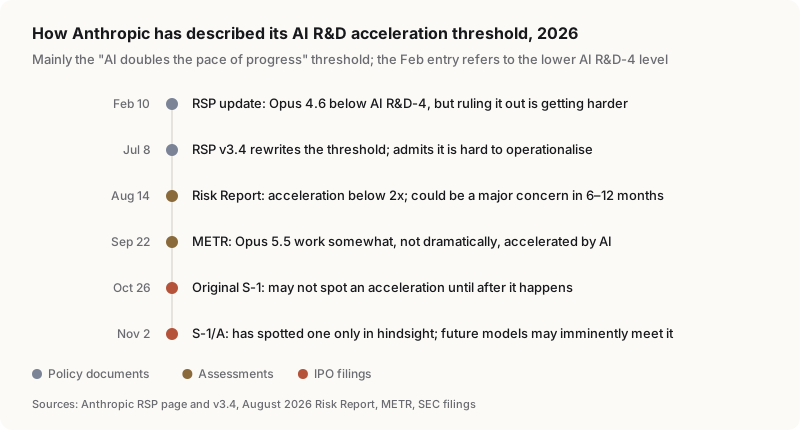
- February 10. An update on the RSP page said Claude Opus 4.6 did not cross the lower AI R&D-4 threshold, but that “confidently ruling out this threshold is becoming increasingly difficult.”
- The August 14 Risk Report, with data to July 15. It concluded that “the overall pace of progress remains below the RSP threshold.” Leading indicators pointed to “meaningful acceleration starting in early-to-mid 2025, though by less than a factor of 2.” The company was “fairly confident” that the 2025 acceleration came from factors other than its use of AI, but believed its models had been “a key factor in the faster trends continuing through the coverage date.” It called the conclusion “uncertain and subject to some lag.” In its overall assessment of this threat model, it judged near-term catastrophic risk low, but said it was “plausible that this threat model will become a major concern in the next 6–12 months.”
- September 22, the outside evaluator METR. In its pre-deployment evaluation of Claude Opus 5.5, METR concluded that the model’s development “was at least somewhat accelerated by AI but is unlikely to have been dramatically accelerated by AI,” and that the model “is unlikely to be able to fully automate AI R&D.” It also relayed a preliminary estimate from a separate METR team: “~1.5X overall acceleration in capabilities due to AI (i.e. 1.5 years in 1 year), with perhaps 30% chance of 2X acceleration.” But METR noted that the estimate did not specify a time period, and that the other team “shared its conclusions with us, but was not able to share the supporting evidence.”
- November 2, the amended prospectus. “May imminently” appears for the first time.
From “increasingly difficult to rule out,” to “less than a factor of 2, possibly a major concern in 6–12 months,” to “may imminently”: three shifts in ten months. Several model releases sit between these documents; the prospectus lists Mythos 5, Fable 5 and Opus 5 among its recent models. It does not publish the “internal estimates” behind the new sentence, so we cannot check them ourselves.
Ninety per cent of the code, and progress still hard to measure
The prospectus gives a few figures that bear directly on “closing the loop”:
- In September 2026, over 90% of contributions to the company’s codebase were written by Claude. In June, according to Scientific American, the figure Anthropic gave was more than 80%.
- The average daily volume of code contributed per engineer in the third quarter was over 45 times the 2024 average.
- On open-ended engineering problems that lack a clear specification and used to depend on experienced human judgement, Claude’s success rate reached about 90% in September, up about 50 percentage points in nine months, on the company’s internal benchmarks.
It is tempting to read these as “AI is already building itself.” Set them against the threshold definition and the gap is large.
The threshold measures the rate of progress in aggregate AI capability, not who writes the code or how much of it. A 45-fold rise in code volume does not mean a 45-fold rise in the pace of capability gains, or even a doubling. That is exactly why the RSP footnote says doubling progress is not doubling researcher productivity. The bottleneck in training a model generation is often not writing code but compute, experiment cycles, and what METR’s report calls researcher “judgement” or “taste”: deciding which experiment to run next and how to read the result.
Why is it hard to measure? The Risk Report gives part of the answer. Anthropic has mainly tracked progress with an internal metric called AECI, adapted from Epoch AI’s Capabilities Index, which folds many benchmark scores into one number. That number exists only after a model has been trained and tested, so it lags by design. The company is also studying leading indicators, but the report says they “are sensitive and not included in the public version.”
Attribution is harder still. Even when the capability curve bends upward, telling whether automated research did it, or more compute, more researchers, or one person’s good idea, is difficult. The Risk Report gives an example: Claude Mythos Preview broke from the previous trend line, but after talking to the people involved, the company attributed it to research progress it did not believe was significantly accelerated by AI.
So my reading is that “we have in the past not identified” is the most informative self-disclosure in the filing. It doesn’t say which time, or how late. But it concedes that where AI is most deeply involved in research, the researchers’ own sense of how fast things are moving lags behind. That is not only Anthropic’s problem. Any team that leans heavily on AI to write code and run experiments will run into it.
Why put this in a prospectus?
TechCrunch’s report noted that an S-1 is both a disclosure and a marketing document. That is a fair reminder.
On one hand, the risk factors section carries real legal weight. Under US securities law, an issuer is liable for material misstatements or omissions in its prospectus. If the company’s own estimates said the threshold might be close and it left that out, investors could point to the omission if the threshold were later crossed. Seen that way, these sentences are the kind lawyers insist on.
On the other hand, “closing the loop” is pitched as one of the company’s biggest structural advantages. “Our models are moving so fast that even we can barely measure it” is, for some investors, a strong selling point. When Anthropic published a blog post on AI building itself in June, Scientific American quoted Noah Giansiracusa, an associate professor of mathematics at Bentley University: “I don’t think it’s a genuine call to slow down.”
I think both readings hold, and you don’t have to pick one. What is more worth noticing is the cost the filing writes down next to them. The amendment says the company has adopted, and may keep adopting, precautionary safety measures. These have included delaying releases and limiting initial access, as with Mythos, which in April was opened only to selected organisations through Project Glasswing. Such measures “may become more frequent and more costly,” and “could slow our capability gains relative to competitors that do not adopt similar constraints.”
Listing “we may have to slow down” as a business risk in a public offering tells shareholders in advance that the company may one day make a decision that hurts short-term growth. That binds more than a blog post does. Whether it will actually do so when the time comes is something no prospectus can guarantee. We will have to watch.
There is also the question of outside verification. On October 14, METR published a methods proposal on how an independent assessor could investigate acceleration from automated AI R&D: look at internal capability measurements, estimates of algorithmic progress and changes in R&D inputs, interview staff, and analyse data on the developer’s own hardware or even on site. That such a proposal needed writing shows no such mechanism exists yet. In September, METR’s own authors did not get to see the evidence behind the key acceleration estimate. For now, “may imminently” is the company’s own assessment.
For teams that work with AI
The frontier lab’s threshold is far from most of us, but the measurement problem it exposes is one many teams already face.
- Don’t treat “how much code AI wrote” as a progress metric. Claude writes nine-tenths of Anthropic’s code and code volume is up 45-fold, yet the company’s own conclusion is that the overall pace of progress has not doubled. If your team reports efficiency as “share of AI-generated code” or “number of PRs,” look as well at outcomes: features shipped, production incidents, time to resolve customer problems.
- Pair lagging indicators with leading ones. Finding out at the quarterly review that “this quarter was unusually fast” or “quality slipped this quarter” is exactly what Anthropic means by spotting it after the fact. Watch a few earlier signals each week: review rejection rates, rollbacks, changes in test coverage, the share of agent tasks that needed a human to step in.
- Leave checkpoints in automated pipelines that a person can actually follow. The filing’s phrase “meaningful human supervision or understanding” is worth borrowing. Oversight means someone understands the change, not just signs off on it. I wrote about review responsibility in Agents now draft 40% of pull requests. Who clicks merge?: the more agents draft, the more it matters that someone has truly read a change before it merges.
- When reading prospectuses and announcements, read the diff between versions. The most informative content here was not in the first draft but in a few sentences added a week later. Risk disclosures, terms of service and privacy policies often work the same way: what gets added or removed is usually the company’s latest judgement.
- Keep “self-improvement” claims concrete. Next time a headline says some model “can now improve itself,” ask three questions. Is it measuring code volume or the pace of capability progress? What is the baseline? Who checked?
Final thoughts
What I care about most here is not the word “imminently” but the sentence before it: we have in the past noticed an acceleration only after it happened.
A company that has made safety its brand admits, in the document where it should be most careful, that its sense of its own research speed lags behind. In the same breath it says the next step could be that early-warning line. Its responses, “considering updates to the RSP,” “keeping humans in control,” “further reports in the future,” are all still in the future tense.
Under its RSP, Anthropic should eventually publish a report on whether the threshold has been crossed. When it does, the thing to watch is not whether the verdict is “crossed” or “not crossed,” but what data it uses to decide, how much outside evaluators get to see, and which concrete rules “keeping humans in control” turns into.
References
- Anthropic, PBC, Form S-1/A Registration Statement (Amendment No. 1), SEC, 2026-11-02
- Anthropic, PBC, Form S-1 Registration Statement, SEC, 2026-10-26
- Anthropic, Responsible Scaling Policy, Version 3.4 (including changelog), effective 2026-07-08
- Anthropic, Risk Report: August 2026, 2026-08-14
- Anthropic, Responsible Scaling Policy page update log, 2026-02-10
- METR, Summary of METR’s predeployment evaluation of Claude Opus 5.5, 2026-09-22
- METR, How an assessor could investigate evidence of acceleration from the automation of AI R&D, 2026-10-14
- TechCrunch, Anthropic warns that it’s very close to RSI capability, aka self-building AI, 2026-11-02
- Gizmodo, Anthropic Claims to Be Near Recursive Self-Improvement, 2026-11-02
- heise online, Anthropic: AI could soon dramatically accelerate its own development, 2026-11-03
- Scientific American, Anthropic warns AI may soon begin recursive self-improvement, 2026-06-05