
Revenue up 47%, and Anthropic is back in the red: the $5 billion of last-minute compute

On Monday, November 2, Anthropic filed an amended S-1 with the US Securities and Exchange Commission and filled in the third-quarter numbers that were blank a week ago.
Third-quarter revenue was $16.96 billion, up about 47% on the second quarter and about 1,127% on the same quarter last year. One quarter of revenue now exceeds the first two quarters of this year combined.
On the same income statement, operating income went from a $974 million profit in the second quarter to a $567 million loss in the third.
On October 28 I wrote in An $80.7 billion loss, and an operating profit that the second-quarter operating profit came mostly from compute costs falling to 48% of revenue. That line has now moved back. According to the filing, the reason is not weak demand but strong demand: $5 billion of third-quarter compute was bought on short-term commitments.
The same day, The Wall Street Journal reported that some institutional investors had told Anthropic and its bankers the IPO valuation should be around $1.5 trillion to $1.6 trillion, a step down from the nearly $2 trillion that had been circulating.
This piece tries to answer three questions: what the third-quarter numbers say, why selling too well can push an AI company into a loss, and what investors are basing their counteroffer on.
The column that was missing
Here are the new numbers. They come from CNBC, Reuters and Business Insider coverage of the amended filing, which agree with one another:
- Third-quarter revenue of $16.96 billion. The second quarter was $11.555 billion and the first $4.731 billion. Revenue for the first nine months totals $33.24 billion, up about 1,200% year on year.
- Sequential growth has slowed sharply. Revenue grew 132% quarter on quarter in Q1 and 144% in Q2, then about 47% in Q3.
- An operating loss of $567 million. Q2 was an operating profit of $974 million.
- A net loss of $23.29 billion. Q2 was $66.3 billion, and the nine-month total is about $104 billion. CNBC reports that most of it still comes from changes in the fair value of convertible notes and derivative liabilities.
- The price range, share count and offering size are still blank.
I took the net loss apart last time. Anthropic issued convertible notes in its early years; the higher the company’s valuation, the more those notes are worth, and the difference is booked as an expense. The smaller net loss in Q3 doesn’t mean the company spent less, only that its valuation rose less steeply than in the quarter before. That line says little about the business, so I’ll leave it there.
The line that matters is operating income, and why it turned negative again.
Slower growth on its own isn’t surprising. When the base goes from $4.7 billion to $17 billion a quarter, sequential growth can’t stay above 140%. Forty-seven percent a quarter still annualises to more than fourfold growth. What I care about more is that revenue grew 47% and costs grew faster.
Demand got ahead of the contracts
Last time I quoted the prospectus on how Anthropic buys compute: usually 12 to 18 months in advance. Those costs are largely fixed and rise with the delivery schedule in the contracts, not with current demand. Margins looked good in Q2 because revenue was outrunning the compute already committed.
The worry I raised then pointed the other way. If demand ever slowed while contracted compute kept arriving and kept being billed, the ratio would snap back quickly.
In Q3 the ratio did snap back, but for the opposite reason.
According to Business Insider, Anthropic’s compute and infrastructure charges rose to about $9.9 billion in the third quarter, roughly a 4x increase in a year by its account. The amended filing says the Q3 operating loss was “primarily driven by $5.0 billion of compute under short-term commitments”, and Business Insider reports the filing says such compute costs significantly more than comparable multiyear arrangements. Reuters puts it this way: about $5 billion of additional compute costs in the quarter weighed on efficiency gains and reduced revenue per dollar of compute from the previous quarter.
I ran a rough number on that. $9.9 billion over $16.96 billion of revenue puts Q3 compute at about 58% of revenue, ten points above Q2’s 48%. As a cross-check, CNBC reports nine-month compute and infrastructure expense rose by $14.4 billion, or 329%. Working back from the Q1 and Q2 figures in the original prospectus, that implies a Q3 figure of about $9.9 billion. The two line up.
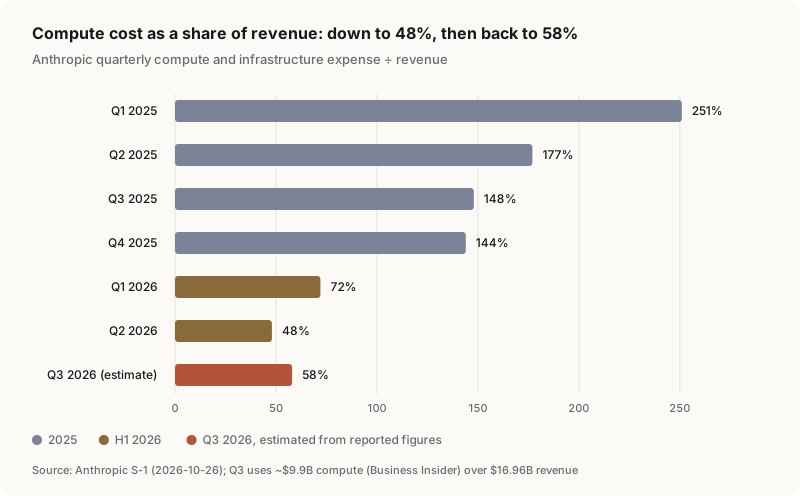
Put together, here is how I read it:
- Long-term compute signed more than a year ago was sized to the demand forecast of the time. Nobody then could have seen $17 billion of revenue in a single quarter.
- In Q2, demand grew faster than that long-term compute, and margins improved. Compute already paid for was fully used, so each extra sale cost very little.
- In Q3, demand kept growing and the long-term compute ran out. To serve it, Anthropic had to buy short-term capacity on the market, at higher prices than its long-term contracts.
- So revenue rose and operating income turned into a loss.
It’s a good problem, but it is still a problem. It tells us Anthropic chose in Q3 to serve the demand first and count the profit later. I think that choice is understandable: in the model market, a customer who leaves because of rate limits or queues is expensive to win back. But it also shows how sensitive this company’s margin is to the timing of its compute contracts, whether demand comes in too low or too high.
An “adjusted profit” and an operating loss can both be true
There is one more thing in these numbers that’s easy to misread.
On October 14, according to the Financial Times, Anthropic briefed prospective investors at its San Francisco headquarters on the third quarter: revenue of about $16.8 billion, an “adjusted profit”, and positive cash flow for the quarter. Reuters and Bloomberg reported the same revenue figure. Three weeks later, the document filed with the SEC shows revenue of $16.96 billion and an operating loss of $567 million.
The two aren’t necessarily in conflict. “Adjusted” measures usually strip out non-cash items such as stock compensation. Business Insider reports a roughly $2 billion non-cash charge in Q3 tied to an employee donation-matching programme, in which employees pledge equity to charity and the company matches with non-voting Class N shares. Set items like that aside and the operating line could well be positive.
But readers should know that the “adjusted profit” described to investors in a meeting and the GAAP operating loss written into the prospectus are two different numbers. My suggestion: whenever you see a headline saying an AI company “is now profitable”, ask which measure, and what was taken out. Anthropic has now published both numbers, which is better than a verbal claim alone, but headlines usually keep only one.
The filing coverage also doesn’t give third-quarter cash flow details. “Cash-flow positive” is, for now, the FT’s account of what was said in the meeting; I haven’t seen a public figure to check it against.
$895 billion, and suppliers who borrow to buy chips
The amended filing gives a total: as of September 30, Anthropic had purchase commitments and lease agreements with an aggregate committed spend of about $895.4 billion, “substantially all of which is related to compute and infrastructure”, in the words CNBC quotes.
According to Reuters, nearly half is expected before the end of 2030, and about $69.8 billion falls due in the 12 months after September 30.
Last time I added up the main compute arrangements named in the original prospectus and got an upper bound above $630 billion. The two numbers are on different bases, one my own sum of specific contracts and the other the company’s total, so they can’t be subtracted to get an “increase”. The scale is clear enough, though: a company with $17 billion of quarterly revenue has nearly $900 billion of compute bills ahead of it.
Reuters highlighted new risk language in the filing:
Certain of our compute providers and infrastructure partners depend on third-party financing or credit support to acquire chips and develop capacity, and if such financing or support becomes unavailable or more costly, contracted capacity may be delayed, repriced, reduced, or not delivered.
In other words, Anthropic has to worry not only about its own funding but also about whether the companies selling it compute can borrow. In Intel loses nearly 30% in a day, OpenAI trims $10 billion I wrote that Blackstone had told investors it expects Anthropic’s post-IPO credit rating to land at the top of junk. Now the prospectus itself says its suppliers are borrowing to buy chips too. When rates and credit conditions shift, the whole chain feels it.
The same Reuters report has a line that people working on AI safety should note: Anthropic said it was considering tighter human oversight of some research and development decisions as its models perform an increasing share of that work. A company writing in a prospectus that its models do a growing share of its R&D is a piece of information in itself.
The investors’ counteroffer
Now the valuation.
According to The Wall Street Journal, institutional investors have told Anthropic and its advisers in the past several days that the IPO should value the company at around $1.5 trillion to $1.6 trillion, partly because of the recent selloff in tech stocks. Reuters, in its report on the amended filing, also said some investors were weighing a $1.5 trillion valuation, down from roughly $2 trillion. Anthropic has not published a price range.
A rough calculation: $16.96 billion of Q3 revenue times four is about $68 billion annualised. A $1.5 trillion valuation is about 22 times that run rate; $2 trillion is about 29 times.
Some reference points:
- The last private round. Several outlets report that Anthropic’s Series H in May valued it at about $965 billion after the money. Even a $1.5 trillion listing would be more than 50% above that, five months on.
- A valuation professor’s number. NYU’s Aswath Damodaran put the company at about $1.48 trillion on his blog on October 28, and wrote that if it is priced well above that, he will sit out the frenzy.
- The market’s reaction. Reuters quotes Matt Kennedy, senior strategist at Renaissance Capital: “I wouldn’t say these results are worrisome, but I do expect some of this pressure on growth and margins to be reflected in the ultimate IPO valuation.”
My view is that the amended filing gives investors two reasons to push back: sequential growth fell from 144% to 47%, and compute costs pulled margins back down, with nearly $900 billion of compute bills to come over the next several years. Neither means Anthropic’s business has got worse. Both mean the story of “hypergrowth with steadily improving margins” is harder to tell than it was a week ago.
On timing, Reuters reports that Anthropic is preparing to begin formally marketing shares to investors next week. Bloomberg reported earlier that trading could start before Thanksgiving on November 26. Accounts differ on the exact dates; the final announcement is what counts.
For people paying attention to AI
- If your company relies on Claude, expect capacity to be tight. A company willing to take a loss to buy expensive short-term compute is clearly facing demand beyond its long-term capacity. For users, that usually means rate limits, queues, priority tiers and price changes are all possible. Keep a fallback model for critical work and test the switch in advance.
- If you run an AI product startup, treat compute as inventory you plan for. Anthropic shows that buying too little compute hurts margins just as buying too much does. If your product is growing fast, review the mix of long-term contracts and on-demand capacity regularly, rather than finding out from the invoice that your marginal cost has doubled.
- When reading an AI company’s results, find three numbers first. Compute cost as a share of revenue, compute commitments due in the next 12 months, and what separates the “adjusted” figure from the GAAP one. These say more about where margins are heading than revenue growth does.
- Watch financing costs along the supply chain. The prospectus itself says compute suppliers borrow to buy chips. Over the next few weeks, the interest rates on new bonds from big tech and cloud companies will show stress in that chain earlier than any single company’s valuation.
- Don’t read one quarter as a trend. The Q3 operating loss could reverse quickly once new long-term compute comes online, or it could persist. I won’t draw a conclusion from this quarter alone before the next report.
Closing thoughts
Last time I said Anthropic’s income statement was set by decisions made a year and a half ago. The third quarter fills in the other half of that sentence: getting it wrong costs money, and so does being too cautious. Demand beyond the forecast has to be bought on the spot, at a higher price.
A large share of the money raised in this IPO will go toward turning that kind of short-term compute into long-term contracts. What investors are haggling over now is not today’s revenue but their confidence in this bet on timing. When the roadshow starts next week, that price will be worked out one table at a time.
References
- CNBC, Anthropic reports $17 billion in Q3 revenue, purchase commitments of $895.4 billion in revised S-1, 2026-11-02
- Reuters (via The Globe and Mail), Anthropic revenue growth slows, compute financing risks mount ahead of IPO, 2026-11-02
- Business Insider (via AOL), Anthropic’s amended IPO paperwork reveals soaring Q3 revenue and a stunning compute bill, 2026-11-02
- Crypto Briefing, Anthropic swings to a $567 million operating loss in amended IPO filing, 2026-11-02
- The Wall Street Journal, Anthropic Investors Push for Cautious Valuation Closer to $1.5 Trillion, 2026-11-02 (as reported by FourWeekMBA and ChainCatcher)
- The Next Web, Anthropic tells investors Q3 revenue reached $16.8bn, FT reports, 2026-10-15
- Aswath Damodaran, The Anthropic IPO Arrives: My (but not the) Anthropic Valuation!, Musings on Markets, 2026-10-28
- Anthropic, PBC, Form S-1 Registration Statement, 2026-10-26