
From "Without Interruption" to "Effective Immediately" in Four Days: What Nvidia Is Missing After Jensen Huang

On the morning of Thursday, November 12, Nvidia put out a press release. Its first paragraph is a single sentence: Jensen Huang “has resigned as President, Chief Executive Officer, and a member of the Board, effective immediately.”
Four days earlier, on Sunday, Nvidia had told CNBC that “Jensen is committed to continuing to lead NVIDIA as CEO without interruption.”
The release goes on. Colette Kress, executive vice president and CFO, has agreed to serve as interim CEO and will stay on as CFO until a permanent successor is named. The board appointed Harvey C. Jones as chair, the first board chair in Nvidia’s 33 years. The board is starting a CEO search and “will consider internal and external candidates.” The whole thing runs to roughly 400 words, and none of them are Huang’s.
CBS reported that Nvidia shares fell as much as 14.3% during the day and closed down 4.3% at $166.19, leaving the company almost $500 billion smaller than at the previous Friday’s close. According to CNBC, the stock spent most of the session below a $4 trillion market value and climbed back above that line just before the close.
I ended my November 10 essay, After the Apology, by saying the board should at least answer one question: if Huang were gone tomorrow, who would run the company? I did not expect “tomorrow” to arrive this quickly. That essay covered the apology letter and the Megaspeed case, so I won’t repeat them. This one is about three things: what the announcement leaves out, what the board has fixed in the past few days and what it still owes, and how all of this reaches people in China who depend on Nvidia compute.
What happened in four days
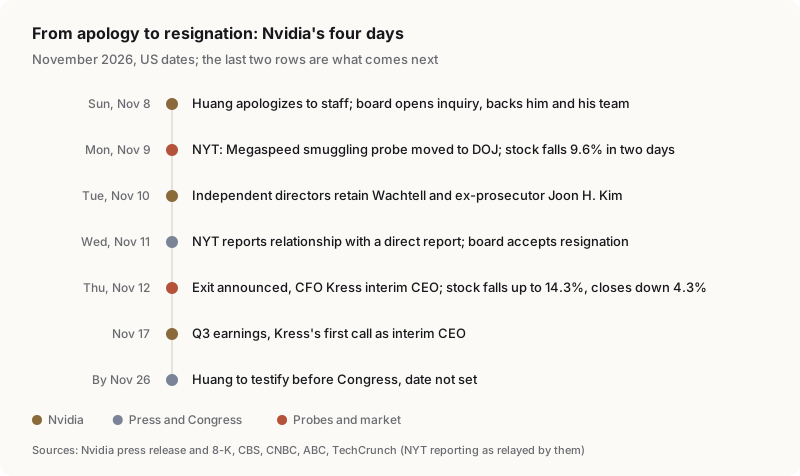
- Sunday, November 8. Huang wrote to all employees and admitted he had been unfaithful to his wife. The board announced an investigation led by independent directors and said it had confidence in him and his team.
- Monday, November 9. The New York Times reported that the Commerce Department’s chip smuggling probe into Singapore-based Megaspeed moved to the Justice Department after Nvidia’s general counsel contacted investigators. CBS says the stock lost 9.6% over Monday and Tuesday.
- Tuesday, November 10. The independent directors said they had retained Joon H. Kim, a former acting U.S. attorney for the Southern District of New York, and his firm Wachtell, Lipton, Rosen & Katz to run the investigation. In my last essay I complained that the board had not even named its outside counsel. Two days later it did.
- Wednesday, November 11. According to CNBC and ABC, the Times reported that Huang had also had a relationship with an Nvidia executive who reported directly to him. That evening several outlets reported that the board was preparing to replace him, and the stock fell about 8% after hours, per AI Weekly’s summary of Fortune’s reporting. The 8-K Nvidia later filed with the SEC states that the board accepted Huang’s resignation and appointed its chair on November 11.
- Thursday, November 12. The announcement went out in the morning. The same day, according to CNBC, Reuters reported a relationship with a second, unnamed employee. President Trump posted his pick for a successor on Truth Social, and House Foreign Affairs Chairman Brian Mast said Huang had agreed to testify before Congress by Thanksgiving.
Two caveats. First, by CNBC’s account, the only thing Huang himself has publicly admitted is what he wrote in the November 8 letter, which named no one. The two later reports involving employees come from the Times and Reuters, and I have not seen a public response to them from Huang or from Nvidia. Second, Fox Business notes in its coverage that there is no public evidence that Huang disclosed confidential information or that anyone obtained Nvidia’s secrets through him.
I still don’t intend to discuss anyone’s marriage. But a CEO’s relationship with a direct report is not a private matter. It is a governance problem. Bernstein analyst Stacy Rasgon told CNBC that it made it “much tougher for the board to leave him in position.”
Four things the announcement doesn’t say
In a CEO transition, what the filing omits often matters as much as what it includes. I went through the press release and the 8-K, and four things are missing.
- No reason. The release says he “resigned.” The 8-K says the board “accepted the resignation.” One TechCrunch story says the company “ousted” him. Rep. John Moolenaar, who chairs the House Select Committee on the CCP, said in a statement, as reported by VOA’s Chinese service, that Huang was dismissed by the company he founded. Outsiders can’t yet tell which word is closest to the truth.
- Nothing on the investigation. Wachtell was retained two days earlier. Whether the investigation continues, whether its scope now includes conduct inside the company, and whether its findings will be made public: neither document says a word.
- Nothing on Huang’s future relationship with the company. The 8-K describes no severance, no advisory role and no treatment of his equity. TechCrunch puts his stake at about 3.5%. Fortune says 3.6%, worth roughly $150 billion. He is no longer a director, but he is still a major shareholder.
- No timeline. Who leads the search, which firm is helping, and how long the board expects to take are all left out. Fortune notes that Bloomberg reported Nvidia is working with an outside firm to identify candidates, without naming it.
The closest thing to a commitment in the release is the board’s expectation that operations, customer commitments and the product roadmap will continue “without interruption.” Four days earlier that phrase was about a person. Now it is about the company without him.
What the board fixed, and what it still owes
To be fair, Nvidia’s board has done three things this week that it had not done in 33 years. It named its outside counsel, appointed a chair, and opened a CEO search that includes outside candidates. Some of the gaps I listed in the last essay have been closed.
The way they were closed raises its own questions.
- The new chair comes from the old board. Jones is 73 and has been a director since 1993. He is a former CEO of Synopsys and has been managing partner of Square Wave Ventures since 2004. Fortune adds that he sits on the board’s nominating and corporate governance committee. At most public companies, succession planning is exactly that committee’s job. Having a director of 33 years preside over the first leadership change in 33 years is steadying, but it is hard to call it fresh oversight.
- The board’s weak spots are unchanged. Last time I cited Semafor’s numbers: average director tenure of nearly 15 years, no current or former S&P 500 CEO, nobody with national security experience. This announcement adds no new directors.
- One person now holds two jobs. Kress is both interim CEO and CFO, and she has to present third-quarter earnings on November 17. What Huang leaves behind is a company with no chief operating officer and about 60 executives reporting straight to the CEO, according to Fortune and CBS. That structure was built around one particular person. Whoever sits in the chair next will have to change it.
TechCrunch points out a fact that is easy to miss. Huang had no supervoting shares, and “the board had the power to vote him out at any time.” That is different from Meta or Google, where founders control the company through dual-class stock. My view is that Nvidia’s board never lacked power. It lacked the habit of using it, and it never prepared for the day it would have to. So when the day came, it had to do in four days, in the worst possible week, what should have taken years of preparation.
Ryan Ellis, an associate professor at Northeastern University who studies infrastructure policy, put it more bluntly: “Individuals fail. Individuals make mistakes. Individuals can be compromised.” Nvidia, he said, had a fairly flat structure that gave the chief executive enormous power, and no succession plan.
Who takes over
Start with the interim. The 8-K gives Kress’s age as 59. The release says she joined Nvidia in September 2013 after nearly 25 years in finance at companies including Cisco and Microsoft. CBS reports that analysts see her as a solid interim choice but not the permanent one. Gil Luria of D.A. Davidson said, “We expect a more comprehensive search.”
For the permanent job, analysts quoted by CBS and Fortune mentioned these names:
- Inside: Ian Buck. He joined Nvidia in 2004, invented CUDA and now runs the data center business. Cody Acree of StoneX said, “Ian makes the most sense internally.”
- Outside chip and cloud executives. Arm CEO Rene Haas, a former Nvidia vice president. AMD CEO Lisa Su. Google Cloud CEO Thomas Kurian. Palo Alto Networks CEO Nikesh Arora. CBS, citing Semafor, says Apple hardware chief Johny Srouji is also among those the board is considering.
- The president’s pick: Tim Cook. Trump wrote on Truth Social on Thursday that Huang “has done a fantastic job” and that “there is only one man to take his place - TIM COOK of Apple.” Cook stepped down as Apple’s CEO in September and is now its executive chairman.
According to CBS, the prediction market Kalshi had Buck at 42%, Kress at 12% and Srouji at 9% on Thursday afternoon. Numbers like these measure sentiment, not what the board is thinking.
Two things matter more to me than the list.
One is speed. Acree said, “If they name somebody quickly, I think it’d be a mistake.” I agree. Ellis argues that because the reporting now involves people inside the company, the problem may not be limited to one person, and that pushes the board toward an outside hire. Recruiting a sitting CEO from another company is never quick.
The other is the job itself. When a U.S. president publicly names his choice for CEO of a listed company, that company stopped being an ordinary company in Washington’s eyes some time ago. The next CEO’s first job may well be the relationship with the government, not the product.
Nobody is left to argue for loosening
For readers in China, I think this is the section that matters most.
David Meale of Eurasia Group told CNBC that Huang had been “the industry’s most effective lobbyist against tighter rules,” and that the scandal weakened Nvidia’s “singular ability to slow the progress of those bills.” CBS also notes that he had pushed the Trump administration to relax some chip export rules. That person is now gone, and pressure is building from four directions at once.
- Legislation. According to VOA, House Speaker Mike Johnson said he supports writing chip export controls into the year-end National Defense Authorization Act. Senate Minority Leader Chuck Schumer named three bills: the AI Overwatch Act, the Chip Security Act, which would require location verification for advanced chips, and the MATCH Act, which tightens controls on chipmaking equipment. A fourth, the Remote Access Security Act, passed the House 369 to 22 in January and is waiting on the Senate. Its target is precisely the practice of renting Nvidia compute overseas.
- A Commerce rule. Gizmodo and CNBC, citing a Wednesday report in The Information, say Commerce is finalizing a rule under which local cloud providers in Singapore, Malaysia, Thailand, Brazil, Indonesia, Norway and South Africa would need a U.S. license before receiving Blackwell or newer chips, and would have to report who gets the chips and what they are used for. Data centers operated by U.S. companies would be exempt if they block remote access for customers from restricted countries. Nvidia has lobbied against the rule.
- Justice Department probes. Semafor reported Thursday, citing two administration officials, that several DOJ investigations could sweep up Nvidia: an antitrust probe focused on the company, and two others focused on Megaspeed and Supermicro. The same story says, “There’s no indication that the DOJ would seek to charge Nvidia, or Huang, criminally at this time.”
- Both parties are investigating, separately. Three Republican committee chairs want Huang’s testimony behind closed doors. On Thursday, Democrats Ron Wyden and Richard Neal wrote to Commerce Secretary Howard Lutnick asking the department to preserve records. Their target is the arrangement under which the government takes a cut of Nvidia’s China sales, according to TechCrunch.
Companies in China are already reacting. Reuters reported Thursday, citing three people familiar with the matter (I read the version republished by South Africa’s BusinessDay), that a major Chinese cloud provider has discussed internally whether to lock in overseas Nvidia capacity ahead of time, that some companies have contacted data center operators about reservations, and that smaller AI labs are considering approaching the big compute rental providers in Southeast Asia. In China’s grey market, traders have started stockpiling restricted chips. CNBC’s live coverage has one number: listings show a set of eight B300 GPUs priced at 20 million yuan, about six times the official U.S. price.
There are forces pulling the other way. According to CNBC, Trump is expected to meet China’s leader on the sidelines of the APEC summit in Shenzhen on November 18 and 19, and analysts think the scandal is unlikely to derail the meeting. Paul Triolo of DGA-Albright Stonebridge warned about the MATCH Act: “Chinese officials have been clear that they will respond to the passage of this legislation.” Gabriel Wildau of Teneo thinks action on remote access “now appears likely,” including putting Megaspeed and other entities on a blacklist.
Here is how I read it. For the past two years Huang himself was the heaviest buffer in U.S. chip policy toward China. He is gone, and an interim CEO from a finance background is not going to stand up for China sales at a moment when Nvidia first has to show that it is clean. So I think the odds of tighter controls in the coming weeks are much higher than they were a week ago. That is my judgment, not an established fact. The bills still have to clear the Senate, the rule has not been published, and the summit could slow everything down.
Notes for four kinds of readers
- Teams renting Nvidia compute overseas. Find out who actually operates your provider. Under the proposed rule as reported, a U.S.-operated data center and a local Southeast Asian cloud would be treated differently, but both could be required to verify end users. Pull out your contract and read the clause on termination for compliance reasons, and ask how quickly you can move your data and model weights. Checkpoint training runs often and make them resumable. Don’t assume a cluster will be available until the contract ends.
- Anyone thinking about stockpiling cards. Most of a sixfold price is a panic premium. Grey-market cards come with no warranty and no clear provenance, and the U.S. side is in the middle of upgrading a smuggling case from an administrative probe to a criminal one. I would rather put the money and effort into adapting to domestic accelerators and cutting inference costs. I wrote about Meituan training a 1.6-trillion-parameter model on domestic chips. That road is much wider than it was a year ago.
- People building products on Nvidia’s stack. You don’t need to worry about a product gap in the near term. Roadmaps are set years ahead, and the release makes a point of saying so. The thing to watch is the November 17 earnings call: who speaks about the technical roadmap, whether guidance changes, and what management says about its large investment commitments. Fortune, citing Anthropic’s filings, says Nvidia agreed to buy about $10 billion of shares alongside Anthropic’s IPO, and the analysts it quoted think that purchase will most likely go ahead. Anthropic is expected to list next Wednesday or Thursday. I covered that private placement in yesterday’s essay.
- People who run teams and companies. Three lessons transfer directly. First, write down what happens if the key person is gone tomorrow, even if it is one page. Second, relationships between a manager and a subordinate are a governance matter, and the rules have to apply to founders too. Third, if your company’s relationships with government, regulators and major customers all run through one person, they all reset to zero when that person falls.
Dates to watch: November 17, Kress’s first earnings call as interim CEO. November 18 and 19, the APEC summit in Shenzhen. Before Thanksgiving on November 26, Huang’s testimony to Congress, which TechCrunch says will be closed-door, with the exact day still being negotiated. By year-end, the final text of the NDAA. And January 3, when a new Congress convenes and, as VOA notes, unfinished bills have to start over.
Final thoughts
Over 33 years Jensen Huang turned a gaming graphics card maker into a supplier the entire AI industry cannot route around. The ending does not rewrite that. The release thanks him for his “immeasurable contributions,” and I think most of his peers would accept the word.
But these four days also show that a company can be ahead of everyone in technology and still be in its first startup year in governance. Last time I wrote that for a founder-built company, the hardest thing is admitting it has grown too large to rely on the founder’s judgment alone. I can now add the second half: the later the admission, the less time there is to catch up, and the worse the conditions.
What happens to Nvidia depends on what its board does over the next few months, not on Thursday’s 400-word release. For readers in China the practical point is a different one. The person who kept arguing for continued sales is no longer at the table, and it is time to plan for tighter rules.
References
- NVIDIA, NVIDIA Announces CEO Transition, 2026-11-12
- NVIDIA, Form 8-K (Item 5.02, date of report 2026-11-11), 2026-11-12
- NVIDIA, Statement From the Independent Members of the NVIDIA Board, 2026-11-10
- CNBC, Nvidia stock closes down over 4% after CEO Jensen Huang announces resignation, 2026-11-12
- CBS News, Nvidia sheds nearly $500 billion in value as Jensen Huang resigns, 2026-11-12
- CBS News, Who will succeed Jensen Huang as Nvidia’s CEO? We asked Wall Street analysts., 2026-11-12
- ABC News, Nvidia closes lower after CEO Jensen Huang resigns, 2026-11-12
- TechCrunch, Nvidia’s Jensen Huang resigns, chipmaker names CFO Colette Kress as interim CEO, 2026-11-12
- TechCrunch, Democrats launch Nvidia investigation, write scathing letter on Huang’s ‘scheme’ with Trump, 2026-11-12
- TechCrunch, Jensen Huang agrees to testify before Congress, 2026-11-12
- Fortune, Nvidia’s Jensen Huang resigns, CFO Colette Kress named interim CEO, 2026-11-11 (later updated)
- Fortune, Report on new board chair Harvey Jones, 2026-11-12
- Fortune, Nvidia’s next CEO: The outside contenders to succeed Jensen Huang, 2026-11-12
- Fortune, Report on what Huang’s resignation means for Anthropic’s IPO, 2026-11-12
- Fox Business, Trump says ‘there is only one man’ to replace Jensen Huang as Nvidia CEO, 2026-11-12
- Semafor, US DOJ probes Nvidia, 2026-11-12
- Northeastern Global News, Nvidia seeks successor after Jensen Huang’s exit wobbles AI industry, 2026-11-12
- CNBC, Jensen Huang’s affair with alleged spy revives push to tighten China chip curbs ahead of Trump-Xi summit, 2026-11-12
- CNBC, Nvidia live updates, 2026-11-12
- Reuters (via BusinessDay), Chinese AI firms rush to secure Nvidia chip capacity as spy scandal stirs fear of US curbs, 2026-11-12
- Gizmodo, China Is Racing to Exploit an Nvidia Loophole Before the Trump Admin Slams It Shut, 2026-11-12
- VOA Chinese, Explainer on lawmakers from both parties weighing swift legislation to restrict chip exports to China after the Huang scandal, 2026-11-12
- VOA Chinese, Report on Rep. Moolenaar’s statement after Huang’s resignation, 2026-11-13
- AI Weekly, Nvidia board moves to oust Jensen Huang (summarizing Fortune), 2026-11-12