
The Rented-Compute Route Closes, and Cursor Says It May Drop Chinese Models: In One Week, Both Ends of China's Open-Model Pipeline Tightened
On Friday, November 20, the House Homeland Security Committee and the House Select Committee on China released a joint investigative report on why, and how, American companies are using AI models built in China. One sentence in it concerns Anysphere, the company behind Cursor:
Anysphere informed the Committees that it plans to explore phasing out PRC-developed open-weight models because of geopolitical risk.
That sentence carries weight. Cursor is one of the largest AI coding tools in the US, and SpaceX completed its acquisition in August at what CNBC describes as an implied $60 billion equity value. Its flagship in-house model, Composer 2, was built on Moonshot AI’s Kimi K2.5.
Four days earlier, on Monday, November 16, the Commerce Department’s Bureau of Industry and Security (BIS) issued an interim final rule closing the route Chinese companies had used to rent advanced compute in overseas data centers. On Thursday, The Information reported that Moonshot had cancelled a $150 million contract to rent Nvidia B300 capacity in Indonesia.
One end of the pipeline is the compute needed to train models. The other is the customers who use them. In a single week, both ends tightened. Here is what the primary documents say, followed by my own reading.
Monday: the rented-compute route closes
When I wrote about Nvidia on November 13, I mentioned that Commerce was “finalizing” a rule on remote access (see From “Without Interruption” to “Effective Immediately” in Four Days). It arrived on November 16. The BIS press release says the rule was “written by and at the direction of the Department of Treasury and the National Security Council,” and is meant to ensure that existing restrictions on sensitive American technology cannot be circumvented through remote computing arrangements in third countries.
Based on client alerts from Katten, K&L Gates and Pillsbury, the rule does four main things:
- A worldwide remote-access control. Wherever a data center sits, if it provides more than 12 million TPP (total processing performance) of compute to a company headquartered in, or ultimately owned from, China, Macau or another Country Group D:5 destination, suppliers need a license to ship it advanced chips. Linked sites that share workloads are counted together. Converted at an H100’s rated performance, 12 million TPP is roughly 760 H100s, which is not a high bar.
- Five countries singled out. Exports of advanced computing chips to or within Indonesia, Malaysia, Singapore, Thailand and Brazil now require a license, reviewed case by case. US-headquartered recipients are exempt but must report monthly.
- Ninety days for existing arrangements. Data centers already serving Chinese companies at that scale must obtain a license within 90 days of the effective date. K&L Gates and Pillsbury say the rule was scheduled for Federal Register publication on November 19, taking effect on publication, with 60 days for comments.
- The Biden-era AI Diffusion Rule is rescinded. The country tiers go, and so do the export controls on model weights.
That last point deserves a moment. The rule controls chips and compute, not model weights. In this round, Washington has chosen to squeeze the training end, not the release end.
The effects were immediate. On Nvidia’s November 17 earnings call, interim CEO Colette Kress said the company has stopped shipping licensed Hopper data center products to China, including the H200. Reuters reported that such sales came to $2.4 billion in the quarter ended October 25. She did not say why the shipments stopped or whether they would resume.
On November 19, The Information reported that Moonshot had scrapped the Indonesia deal: a $150 million agreement to rent B300 capacity from a Southeast Asian neocloud with a data center in Indonesia. Accounts of what happens next differ. Some say Moonshot has signed with a different Southeast Asian provider; others say it is still looking, including in Europe. CNBC reported on November 5, citing people familiar with the matter, that Moonshot had been in talks this year to rent 8,000 or more Blackwell GPUs from European neoclouds. Under the new rule, though, a European facility serving a Chinese company above the threshold needs a license too.
China’s big platforms responded on their earnings calls. According to Fortune, Tencent president Martin Lau called the restrictions “unfortunate” on November 18, said the next round of Hunyuan training would take longer, and added: “It sets everyone back in China.” Chief strategy officer James Mitchell said Tencent’s cloud mostly runs inference: “We actually don’t see an impact.” On November 19, Alibaba CEO Eddie Wu said progress on domestic compute was “already ahead of our original expectations,” but that the new rules “will affect next year’s products and services.”
Friday: one report, three companies
The House report is signed by Homeland Security chairman Andrew Garbarino and China committee chairman John Moolenaar. The investigation ran for seven months. Letters went to Airbnb and Anysphere on April 29, and to DoorDash on July 31. All three submitted documents and briefed committee staff.
The report uses the three as case studies, and it is specific:
- Airbnb runs Alibaba’s Qwen in customer support. It operates customized Qwen models on US-based service-provider infrastructure, powering an AI assistant that handles about 80,000 guest and host interactions a day, plus a fine-tuned model that summarizes roughly 250,000 support cases and calls daily. CEO Brian Chesky said last year that Airbnb chose Alibaba’s model because it was “fast and cheap.”
- Cursor’s Composer 2 sits on Kimi K2.5. The report pointedly notes that this “became public only after an independent developer identified the underlying model.” That was in March.
- DoorDash uses the most. It told the committees its engineers had downloaded or evaluated models from at least six Chinese developers, and that 25 Chinese model families had been authorized and deployed in a “non-trivial” way, defined as at least $5,000 in compute and serving costs. Replacing one model embedded in a larger system could take up to six months; most other uses could be switched almost immediately.
Their stances differ. After the White House publicly accused Moonshot of illicitly distilling an American model and acquiring restricted chips, DoorDash told the committees it had no independent knowledge of the allegations, that the public information did not identify specific risks, and that it had not changed the deployment, permissions or monitoring of the Moonshot model it uses. Airbnb kept Alibaba models on its approved-for-production list after the Department of War designated Alibaba a Chinese military company. Then comes the line: “By contrast,” Anysphere plans to explore phasing them out.
To be precise: “explore phasing out” is the report’s account of what Anysphere told the committees. It is not a public statement from Cursor, and it is not a decision. Cursor and SpaceX did not respond to CNBC’s requests for comment.
Why they use them: cheap, adaptable, good enough
What surprised me about the report is how much space it devotes to explaining, fairly, why these companies chose Chinese models.
First, price. Table 2 compares published API rates for one standard workload, one million input tokens plus one million output tokens:
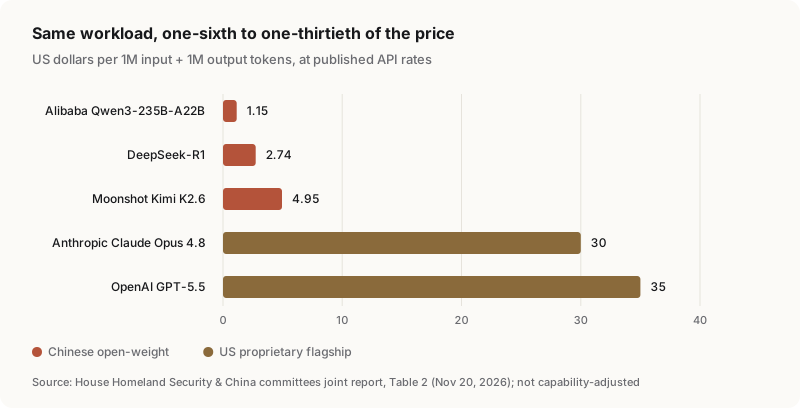
Alibaba’s Qwen3-235B costs about $1.15, DeepSeek-R1 about $2.74, Kimi K2.6 about $4.95. Anthropic’s Claude Opus 4.8 is about $30 and OpenAI’s GPT-5.5 about $35. The report notes that these figures are not adjusted for capability, caching, batch discounts or self-hosting costs. Still, the order of magnitude is clear: six to thirty times.
Second, control. Open weights can be fine-tuned on your own data, run on your own hardware, and are immune to a vendor changing terms or cutting you off. Airbnb’s internal evaluation rated open-weight candidates as offering “full flexibility” for fine-tuning, versus “limited flexibility” for proprietary ones. DoorDash told the committees that open-weight models “reduce the risk a single developer could change or turn off access to a model without notice.” The report also recounts that after Hugging Face was breached in July, American frontier models refused to help with parts of the defensive response because their safeguards could not tell a defender from an attacker, so Hugging Face finished that work with Zhipu’s open-weight GLM-5.2.
Third, quality. On DoorDash’s internal code-review benchmark, a pairing of Kimi K2.6 as first reviewer with Claude Fable 5 as second scored highest of any configuration, more than 20 points ahead of pairings led by American open-weight models. In the independent ranking the report cites, the best American open-weight model placed tenth, behind six Chinese models. Over the past year, Chinese models accounted for 41 percent of downloads on the leading open-model repository.
The report’s conclusion for Washington is blunt: the United States lacks a competitive open-weight alternative “at the price and performance the market demands.”
What the report asks for, and what it doesn’t
The report is not a brief for Chinese models. Its other findings are sharp. US agencies assessed that six leading Chinese developers ran “industrial-scale” distillation campaigns against American frontier models. American data-labeling firms reportedly earn about $500 million a year selling training data to Chinese labs. Some Chinese models produced less secure code when prompts referenced politically sensitive topics. These are US allegations and assessments that I cannot independently verify, but the report’s argument rests on them.
Its recommendations are carefully tiered. There are twelve, and the hardest are these:
- A ban in federal systems and federal contract work. Extending the DeepSeek order, issued in July and made public in October, to all Chinese-developed models and their derivatives, covering federal information systems and work performed under federal contracts.
- Phased removal from critical infrastructure. High-risk functions must drop them, but on timelines tied to whether a trusted alternative exists.
- A provenance standard. NIST would develop a model-provenance standard and an “AI bill of materials,” mandatory for federal contractors and high-risk critical infrastructure, voluntary for everyone else.
Toward ordinary businesses, the report is restrained. Its foreword warns that forcing companies off Chinese models before trusted open-weight alternatives exist “would raise their costs and concentrate the market in a small number of closed, proprietary providers.” Its first recommendation is therefore to build an American open-weight alternative, with public compute, shared evaluation and “lawful access” to American frontier models for training.
The report also flags a risk running the other way: dependence cuts both ways. Moonshot’s Kimi K3 license requires model-as-a-service providers with more than $20 million in annual revenue to negotiate a separate commercial agreement. Reuters has reported that Alibaba plans to charge large users of its next Qwen release, that Moonshot sought up to 30 percent of revenue from K3 services on major American clouds, and, in July, that meetings led by China’s Ministry of Commerce discussed restricting overseas access to the country’s most advanced models. The report’s point: what is cheap to adopt today could come with new terms, or be cut off, tomorrow. That is the mirror image of DoorDash’s reason for choosing open weights.
Finally, this is a congressional investigative report, not law. Its recommendations need legislation or executive action to take effect.
My view: where the pressure lands
Put the two events side by side and, as I read it, Washington’s approach this round is: let the models out, choke the compute, and make users know what they’re running.
On compute, the damage is to training, not inference. The two Tencent executives sound contradictory but are describing the same thing: domestic chips can carry inference, while training slows down. Renting overseas compute was an important supplement for Chinese labs training frontier models. Moonshot was named over Thailand, cancelled in Indonesia, and is shopping in Europe; that path keeps narrowing. A 12 million TPP threshold catches essentially any large training run. Over the next year, the release cadence of China’s frontier models may well track the ramp of domestic compute.
On customers, the damage is to anything with an unclear lineage. The report does not ask ordinary businesses to stop using Chinese models, but it puts a finger on Cursor’s sore spot: its base model was uncovered by an outside developer rather than disclosed. If a provenance standard takes hold, even one mandatory only for federal contractors, procurement and legal teams at large companies will start asking the same question: what model is underneath your product? For a company like Cursor, the issue is no longer whether Chinese models are good, but whether it can write the answer on a purchase order.
Cursor’s statement reflects its own position. This is my inference: Cursor now belongs to SpaceX, CNBC notes it has been involved in training SpaceX’s Grok models, and SpaceX does a great deal of government business. For Cursor, the commercial cost and political payoff of switching base models look nothing like they do for DoorDash or Airbnb. So I would not read Cursor’s line as a signal that American companies are turning away en masse. The other two companies in the report chose to keep going.
The people caught in the middle have the least leverage. Compute rental providers in Southeast Asia have Chinese customers on the other side of their contracts. American startups using Chinese models now face the report’s lineage questions and, at the same time, Chinese developers tightening their license terms. Neither group writes the rules, and neither has much bargaining power.
For teams in China building models or selling abroad
- Reread your compute contracts. Especially if the facility is in Southeast Asia or the provider is not US-headquartered. Find the clause on termination for compliance reasons, and confirm how quickly your data and weights can be moved. Make training jobs resumable from checkpoints; don’t assume an overseas cluster will last until the contract ends. The 90-day window is for providers to apply for licenses, not for you.
- Disclose your base model before someone else does. If you sell abroad and your product sits on your own or another Chinese lab’s model, say so in the technical report and model card. Cursor’s lesson is that being found out is harder to explain than being asked.
- Prepare a model bill of materials. Which models, which versions, deployed where, with data flowing where. Even before any US standard lands, these questions are already showing up in large overseas customers’ security questionnaires. Doing it early is far cheaper than scrambling later.
- A price advantage is not a moat. Price tops every reason the report gives for adoption. But building a competitive American open-weight alternative is now its first recommendation, and Reflection AI and Mistral both released new open-weight models in October. The gap will narrow. What keeps customers is control, auditability and clear documentation.
- Keep license terms stable. If you publish open-weight models, what overseas users fear most is open today, paid tomorrow, restricted the day after. The report uses exactly that as evidence. The clearer and steadier your terms, the harder it is to describe them as “hook them first, raise prices later.”
Closing thoughts
What struck me most this week is something the report concedes: American companies use Chinese models not because they are naive about the risks, but because nothing else meets the price and performance they need.
So this round of controls is, at its core, buying time for America’s own open-weight ecosystem. Squeeze training to slow Chinese iteration; demand transparency to raise the cost of continued use; and meanwhile invest in alternatives. Whether it works depends on whether American open models can catch up in a year or two, and on whether teams in China can keep today’s price-performance under tighter compute.
For teams in China, compute is largely out of their hands. Being clear about who you are is not. Model lineage, data flows, license terms: the more clearly these are written down, the less room others have to define them for you.
References
- H. Comm. on Homeland Security & H. Select Comm. on China, Joint Investigative Report on PRC-Developed AI Models (full report), 2026-11-20
- House Homeland Security Committee, Chairmen Garbarino, Moolenaar Release Joint Investigative Report Urging Removal of PRC Open-Weight Models From Federal Systems, High-Risk Critical Infrastructure, 2026-11-20
- Kai Nicol-Schwarz, SpaceX’s subsidiary Cursor tells lawmakers it’s considering phasing out Chinese AI models, CNBC, 2026-11-20
- Erik van Klinken, Cursor is considering phasing out Chinese AI models, Techzine Global, 2026-11-20
- Bureau of Industry and Security, BIS Issues Rule Addressing Remote Access to American Super Intelligence Technology, 2026-11-16
- Katten, Commerce Department Releases New Export Rules for Advanced AI Chips and Data Centers, 2026-11-17
- K&L Gates, BIS Targets Remote Access to Advanced Computing: New Controls for Semiconductor Companies and Data Centers, 2026-11-18
- Pillsbury, Commerce Restricts Remote Access to Advanced Chips, 2026-11-17
- Al Landes, Moonshot AI Cancels $150 Million Nvidia B300 GPU Rental Deal in Indonesia, Gadget Review / Yahoo Finance, 2026-11-19 (citing The Information)
- Hannah Collymore, China’s Moonshot drops $150M Indonesia Nvidia deal days after US crackdown, Cryptopolitan, 2026-11-19
- Reuters, Nvidia stops shipping US-approved AI chips to China, via BusinessDay, 2026-11-18
- Jay Ganglani, Alibaba and Tencent put their faith in Chinese chips after new U.S. export controls, Fortune, 2026-11-20
- CNBC, Moonshot AI sought Nvidia Blackwell chip access in Europe, 2026-11-05